
Suchergebnisse
1. Ausschreibung - Driving Urban Transitions Partnership
Die von Österreich koordinierte Horizon Europe-Partnerschaft "Driving Urban Transitions" startete ihre erste transnationale Ausschreibung. 41 Forschungsförderungs-Institutionen aus 27 europäischen Ländern stellen ein Budget von insgesamt 70 Mio. € zur Verfügung. Einreichfrist: 21. November 2022
CO2-Demobau - Sondierung zur Durchführbarkeit CO2-neutraler Demonstrationsbaustellen
Durch Aufzeigen von grünen Innovationen, Vernetzung mit Stakeholdern der Baubranche und Anwendung der Erkenntnisse der Vorstudie "CO2 neutrale Baustelle" wird das Fundament für zukünftige CO2-neutrale Demonstrationsbaustellen gelegt. Diese Baustellen dienen als Best-Practice-Beispiele für die Bereiche Vergabe, Baubetriebsorganisation und -technologie.
CO2-Demobau - Exploration of the feasibility of carbon-neutral model construction sites
By highlighting green innovations, networking with stakeholders in the construction industry and applying the findings of the previous study "CO2 neutrale Baustelle", the foundation is set for future carbon-neutral model construction sites. These construction sites will serve as best-practice examples in the fields of contracting, construction operations organization and technology.
PV Marketing
Development of quality assurance by the photovoltaic quality seal and training activities.
PV Marketing
Entwicklung von Qualitätsinstrumenten wie Gütesiegel und Unterlagen für die Ausbildung.
Smart Cities
Die Stadt ist das weltweit vorherrschende Organisations- und Wettbewerbsmodell für das menschliche Zusammenleben in einer zunehmend globalisierten Wirtschaft. Mehr als die Hälfte der Weltbevölkerung lebt bereits in Städten - in Europa werden es bis 2050 bereits 85% sein!
Berichte aus Energie- und Umweltforschung 1/1997 Car Sharing

Car Sharing im Rahmen finanzieller, verkehrspolitischer und umweltpolitischer Entscheidungsgrundlagen im Verkehr
Aktuelle Ausschreibungen
IÖB-Leitfaden
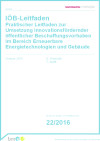
Praktischer Leitfaden zur Umsetzung innovationsfördernder öffentlicher Beschaffungsvorhaben im Bereich Erneuerbare Energietechnologien und Gebäude (Version 2016).
Schriftenreihe
22/2016
H. Warmuth. T. Steffl
Herausgeber: BMVIT
Deutsch, 25 Seiten
Downloads zur Publikation
Dialogprozess Energiezukunft 2050
In diesem breit geführten Diskussions- und Konsultationsprozess „Dialog Energiezukunft 2050" werden Vorschläge für Zielsetzungen, Schwerpunkte und Themen erarbeitet und abgestimmt, die in der Folge in eine überarbeitete Energieforschungsstrategie Eingang finden werden. Intelligente Technologiesysteme und sozio-ökonomische Aspekte einer innovationsgetriebenen klimaverträglichen Energiezukunft werden dabei fokussiert.
Strategies and Operator Tools for Grid Restoration with Massive Renewable Energy Sources (RestoreGrid4RES)
RestoreGrid4RES behandelt die zukünftige Erzeugungsstruktur auf Basis erneuerbarer Einspeiser im Zuge der Transformation auf eine erneuerbare und ökologische Stromversorgung. Das Projekt wurde im Rahmen der „Joint Programming Platform Smart Energy Systems“ (JPP SES) durchgeführt.
Strategies and Operator Tools for Grid Restoration with Massive Renewable Energy Sources (RestoreGrid4RES)
RestoreGrid4RES faces the future renewable based generation structure within the transformation to a renewable and ecological power supply. The project had been funded in the frame of the „Joint Programming Platform Smart Energy Systems“ (JPP SES).
CEPAM – Circular Economy Powder for Additive Manufacturing
In the CEPAM research project, a recycling process for high-quality metal powders for additive manufacturing is developed. Various methods of energy input are being evaluated for energy efficiency, scalability and powder quality and built up on a pilot scale. The recycled metal powder is characterized and processed in the Laser Powder Bed Fusion process. In order to compare the mechanical properties of the printed components, parts are printed from both new and recycled powder.
NNATT - Sustainable use of excavated materials from civil engineering and tunnelling using sensor-based technologies
The holistic system developed in the NNATT project for the sustainable utilisation of excavated materials starts with the geology and extends through the construction process to recycling. With the help of sensor-based real-time analyses and an AI-supported decision matrix, excavated materials are separated and further developed into customised products.
Themen
SHyRE - Sulfuric acid and hydrogen production for the electronics industry through innovative recycling
In SHyRE, an innovative process for sulfuric acid recycling is being developed. The aim is to efficiently produce high-purity sulfuric acid and hydrogen by combining novel decomposition processes with electrochemical methods.
KAFKA - Development of cascade reactions for a circular economy
KAFKA aims to expedite the development of biorefinery processes and showcase the potential of process cascades for producing high-quality chemical products from biogenic resources/waste. The central element of the project is an innovative reactor platform that flexibly combines biotechnological, electrochemical, and thermal processes. Investigations into new process cascades to enable a circular economy are thereby accelerated.
CycLR - Paint recycling and utilization of components
The CycLR project aims to implement a circular economy for water-based paints. A recycling process that enables the valorisation of recyclates is being developed, taking into account all parties involved in the value chain.
CE4ALL – Circular economy for all – Incentives, enablers and inhibitors for sustainable consumption
Based on an analysis of current milieu-specific consumption behavior, the CE4ALL project aims to identify sector-specific incentives and enablers for strengthening the circular economy and to uncover inhibitors. Another focus of this work is the consideration of inclusion aspects. CE4ALL is working on a consumption-centered investigation beyond the previously production-oriented considerations of the circular economy.
IRONER - Potential for innovative and sustainable recycling of steel
Within the framework of the IRONER project, open questions were identified and the necessary innovations for increased steel recycling were developed. In addition to a material flow analysis, stakeholder interviews and ecological and economic considerations, the influences of increased steel recycling on metallurgical processes and material properties of steel products were examined.