
Suchergebnisse
"gugler! build & print triple zero" - Subproject 8: Leuchtturm gugler – Ökoeffektive Plusenergiedruckerei
On the basis of the commercial building gugler with 2140 m² useable floor area existing and 3260 m² useable floor area to be built a concept for a 100% recyclable ecoeffective building had been developed.
Decarbonisation of industry
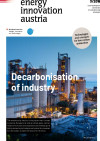
Ways to achieve a zero-emission industry. Innovation is the key for climate-friendly production.
energy innovation austria
3/2019
Herausgeber: BMVIT und Klima- und Energiefonds
Englisch, 12 Seiten
Downloads zur Publikation
Energy Efficient University Buildings
Potentials, measures and perspectives at Austrian universities
Forschungsforum
3/1999
Herausgeber: BMVIT
Englisch, 6 Seiten
Downloads zur Publikation
Future-Oriented Products And Services
New Approaches to innovative and environmentally sound produc design
Forschungsforum
1/1998
Herausgeber: BMVIT
Englisch, 6 Seiten
Downloads zur Publikation
Building With Renewable Raw Materials
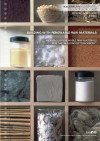
Indigenous Renewable Raw Materials for the "Building of Tomorrow"
Forschungsforum
4/2002
Herausgeber: BMVIT
Englisch, 6 Seiten
Downloads zur Publikation
Development of a new generation of grid-connected PV inverters
Improvement of operational parameters (efficiency, quality of current waveform, reduced size and weight) and reduction of manufacturing costs
Feed-in and system integration of biogas in existing gas grids
Method for assessment of technological aspects of biogas supply to existing gas grids. Definition of characteristic numbers for quantitative an qualitative analysis. Aspects of systems integration.
Wood Plastic Composites - New property profile by refiner fibres
The mechanical properties and thus the application area of wood plastic composites with a wood content > 60 % shall be explicit increased by means of long wood fibres. The realization of a technological direct feeding system in extrusion process will enable an innovation jump of this wood like material.
Bioenergy and Sustainable Development - Climate Change Mitigation and Opportunities for Sustainability Co-Benefits
23. - 24. May 2022
Online, AT
The aim of this e-Workshop is to provide practical information to qualify the contributions of bioenergy to climate change mitigation, highlight the opportunities and co-benefits of biomass supply chains (beyond energy provision) and open the prospects of stimulating such co-benefits and managing trade-offs.
Climate-neutral industry
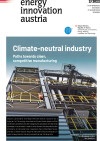
Paths towards clean, competitive manufacturing
energy innovation austria
2/2022
Herausgeber: BMK in cooperation with the Climate and Energy Fund
Englisch, 16 Seiten
Downloads zur Publikation
LINE-FEED - Plug-in Photovoltaic Storage for the Wall Socket
The project LINE-FEED developed technologies that are required for a photovoltaic storage system which can be installed by anybody by simply plugging it into a wall socket. The aim was to create a storage system for households in urban areas that do not have the possibility to install a photovoltaic system themselves.
3rd IEA SHC Task 65 - Austrian National Workshop
8. April 2024
Hotel Europa, Graz, AT
This is the third of three workshops of the IEA SHC Task 65, which takes place at the national level. The purpose of these workshops is to bring together collected Austrian know-how into Task 65 and to reflect the findings of international experts, as well as to test the tools and methods developed.
Climate-friendly buildings
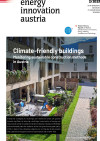
Monitoring sustainable construction methods in Austria
energy innovation austria
2/2023
Herausgeber: BMK in cooperation with the Climate and Energy Fund
Englisch, 12 Seiten
Downloads zur Publikation
IEA EGRD Workshop: Social Impacts of Clean Energy Policies
23. Mai 2023
Online
This workshop, organised as part of the IEA’s people-centred clean energy transitions work programme in collaboration with the IEA Experts’ Group on R&D Priority-setting and Evaluation (EGRD) explored existing research assessing the social impacts of clean energy policies on low-income households.
Pioneering Austrian Cities
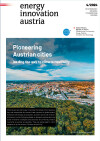
Pioneering Austrian cities leading the way to climate neutrality.
energy innovation austria
4/2024
Herausgeber: BMK in cooperation with the Climate and Energy Fund
Englisch, 12 Seiten
Downloads zur Publikation
Workshop: Towards a Consumer-Driven Energy System
12. - 13. October 2017
Technical University of Denmark, Lyngby, DK
This workshop focused on "A Consumer-Driven Energy System: Understanding Human Behaviour". Participants explored the individual and organisational behaviour and decision-making related to the energy use in order to inform more effective R&D planning and policies.
Resource-efficient production
The Austrian Federal Government‘s strategy for research, technology and innovation (RTI) includes the statement that research and technological development will play a vital part in meeting the great social challenges of our time.
Office Building WKS - Plus Energy Office Building in Ernstbrunn
The new office building (headquarter) of Windkraft Simonsfeld AG in Ernstbrunn (Lower Austria) is planned as a plus energy building. From this excellent starting conditions it is intended to make seven more steps to explore innovative options for energy plus buildings.
ZERMET - Zero Emission Retrofitting For Existing Textile Plants
Minimisation of the consumption of water, chemicals and energy in the textile industry. Further development of the ZERMEG approach in the form of a questionnaire and application in the textile industry.
Exhibition "Architecture and Passive House Standard in Austria"
The aim of the exhibition is to show the compatibility of the building quality standard "Passive House-Standard" with the requirements of the best architectural design with well-chosen examples and explanations. In this way these Austrian cultural and technical achievements shall be made more public.