
Suchergebnisse
InSite - Monitoring and evaluation of innovative demonstration buildings
In the "Stadt der Zukunft" and "Smart City Initiative" programmes, a large number of demonstration projects have been implemented in recent years. To be able to evaluate the developed innovations in a uniform and comparable form and to make the knowledge gained accessible to implementers, InSite subjects 10 selected objects from these programmes to energy and ecological monitoring as well as sociological surveys over a period of 24 months. The interpreted results are publicly available as a published study and as an interactive online platform.
FavoriteFlows – Innovative solutions for water and energy cycles in buildings for a climate fit city
Demonstration of detailed planning work and implementation of water cycles (building-integrated constructed wetland wastewater treatment) and energy cycles (wastewater heat exchanger) on a large residential apartment development for climate resilience, resource efficiency and high living standard.
Co-Housing Gutenberg: Integrated Sector Coupling for Shared Living, Energy, and Mobility
The "CoHoGutenberg" project aims to establish a sustainable co-housing model in the rural community of Gutenberg, Styria, by combining sufficiency principles with state-of-the-art energy technologies.
ReSpace – Reclaiming Spaces
ReSpace is developing an AI-based model for identifying, categorizing, and activating sealed areas. Existing data sources (aerial and satellite images, mobile network data, land registry entries) are integrated and enhanced with dynamic analysis to derive evidence-based recommendations for action.
ReCon: Development of a resilient hook-and-loop-fastening-system for the adaptable assembly of building components in the building industry
Systemic examination of the hook-and-loop fastener and building component interfaces for the development of a resilient fastening system between parts/components with different functions and lifespan. The result serves to verify the fastening system and forms a basis for further research and establishment in the building industry.
DieWärmePioniere - Participatory climate transformation roadmap as basis for a demo district in the gas-supplied Kahlenbergerdorf
Development of a transformation roadmap for the decarbonization of a neighborhood and implementation of a subarea. Securing acceptance of the project and raising awareness through an active participation process of the population and the establishment of an energy community for heat supply.
# Murau : Real-World Laboratory of energy transition for inner-alpine regions
Inner-alpine regions are rich in the natural resources water, sun, wind and biomass. This study investigated how the Murau region can become a stable and fail-safe, renewable 100% region and how it is possible to supply the energy-hungry conurbations as a needs-based energy export region.
TWIN - Digital twins for sustainable buildings
Digital building twins have hardly been used in practice due to an often unfavourable cost-benefit ratio. The aim of the TWIN project is to bring together use cases of digital building twins with a high ecological and economic impact in order to prepare application scenarios with great implementation potential.
OctoAI: The next generation of high-performance edge AI for smart buildings
Current IoT (Internet of Things) solutions for buildings depend almost exclusively on cloud infrastructure and cloud-based services. In the OctoAI project, we are developing the next generation of high-performance Edge AI (Artificial Intelligence) for smart buildings. In OctoAI, we combine the concept of edge AI with user-centric energy services and test two edge-ready applications.
Beyond - Virtual Reality enabled energy services for smart energy systems
The Beyond project addressed two different energy services through the interaction of various technologies: state-of-the-art virtual reality (VR), the Internet of Things (IoT), energy simulation and machine learning (ML). Energy service 1 immerses VR users in energy-efficient and sustainable building design through an educational VR game, while energy service 2 improves the maintenance of building systems, particularly heating, ventilation and air conditioning (HVAC) systems, through the application of ML models for predictive maintenance.
VITALITY District - Optimized energy concepts in the early planning phase of resilient, energy-efficient neighbourhoods
The aim of the VITALITY District project is to coordinate the total (electrical and thermal) load and generation profile in the design phase of urban areas and neighbourhoods in order to optimize the energy concept of energy-efficient districts. Hence smart city indicators in detailed level (buildings, individual technologies, public spaces) as well as models, principles and catalogs of criteria for energy-optimized urban neighbourhoods were created. The results were presented in compact form on the district level in order to serve as input for future urban planning projects.
Vilipa - Visible light based Person and Group Detection in existing buildings
Zur Reduktion des Energieverbrauchs von Gebäuden können Belegungserkennungssysteme einen großen Beitrag leisten. Dieses Projekt zeigt die Machbarkeit des Erkennens von Personen anhand der Reflexion von sichtbarem Licht, hervorgerufen durch die Person selbst, demonstriert, wobei die bestehende Beleuchtungsinfrastruktur zur Personenerkennung ohne Datenschutzbedenken eingesetzt werden kann. Der realisierte Ansatz ist sowohl kostengünstig als auch unaufwändig hinsichtlich der Installationskosten.
KityVR - Artificial intelligence techniques to implement CityGML models and VR visualization
The KityVR project deals with key research aspects at the interface between 3D city models and virtual reality. It addresses questions such as how virtual reality can be used for visualization in the field of 3D city models and how machine learning and statistical methods can be used to enrich or complete energy-related data sets.
Reallabor 100% renewable energy Waldviertel
Under the motto "Always one step ahead", the aim is to develop a content-related and economic implementation concept for a "Reallabor 100% erneuerbare Energie Waldviertel".
IEA Bioenergy Task 39: Biofuels to Decarbonize Transport (Working period 2022 - 2024)
The long-term goal of Task 39 is to drive decarbonisation in the transport sector using biogenic, sustainable, low-carbon fuels. This includes conventional and advanced biofuels that can be produced via different technological routes (oleochemical, biochemical, thermochemical and hybrid). In the 2022-2024 triennium, the focus was increasingly on long-haul transport, which is more difficult to electrify.
Thermal energy storage - a key component of the future energy system
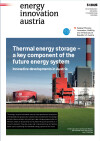
Innovative developments in Austria
energy innovation austria
3/2025
Herausgeber: BMIMI in cooperation with the Climate and Energy Fund
Englisch, 12 Seiten
Downloads zur Publikation
REal - The laboratory for Integrated Regional Renewable Energy Systems
In the REal project, a holistic, scalable and user-friendly concept was created, whereby sector-coupled, municipal energy systems with 100% renewable energy can be implemented, considering all necessary aspects from planning to operation, reducing design costs and accelerating an Austria-wide implementation.
ExTra - ExergyTrafos for heating and air conditioning through district heating
As a contribution to the reduction of CO2 emissions, the project aims at upgrading existing heating networks by adding new devices, so-called exergy trafos, to the heat-exchanging transfer stations. These are driven by district heat and provide heating and cooling, as well as a reduced return temperature, as a service.
BIMpeco - Environmentally relevant product data in collaborative BIM environments
Construction products can pose a risk to the environment and health due to their pollutant content or releases. In the BIMpeco project, workflows and data structures for digital information management of this environmentally relevant product data are developed. For this purpose, the new ISO standards ISO 23387 and ISO 19650-1 are tested and synchronized with established process flows. The project results will be made available on an open-source basis and can be integrated into any Common Data Environment (CDE) that complies with the standards mentioned. The BIMpeco project is the first to lay the foundations for product information management of environmentally relevant properties in the CDE, covering the entire lifecycle and supply chain.
MURREAL: Murtaler Reallabor - On the way to 100% renewable energy by 2040
MURREAL connects the actors of the industrial region Murtal with specialists in the field of high tech and materials with the raw material and energy sector, service providers and research and development. In this exploration for a real laboratory, synergies had been worked out and business models had been built up to consistently take the path towards 100% renewable energy and climate neutrality by 2040.