
Suchergebnisse
solSPONGEhigh - High solar fraction by thermally activated components in an urban environment
Within this project the intensive use of thermally activated building elements (TABs) as an additional thermal storage in different buildings, with solar technologies (thermal, PV) preferred for energy supply, was investigated. The aim was to activate and use the thermal storage potential that is immanent in the building elements and thereby achieve solar coverage of the building's heat demand of nearly 100 %.
31st European Photovoltaic Solar Energy Conference and Exhibition (EU PVSEC 2015)
14. - 18. September 2015
CCH Congress Center HamburgHamburg, DE
The EU PVSEC is the largest international Conference for Photovoltaic research, technologies and applications, and at the same time a top international PV Industry Exhibition.
32nd European Photovoltaic Solar Energy Conference and Exhibition (EU PVSEC 2016)
20. - 24. June 2016
ICM - Internationales Congress Center MünchenMünchen, DE
The EU PVSEC is the largest international Conference for Photovoltaic research, technologies and applications, and at the same time a top international PV Industry Exhibition.
Eco.District.Heat - Potentials and restrictions of grid-bound heating systems of urban areas
Aim of the project Eco.District.Heat is to provide strategic decision-making support that enables Austrian towns and cities to deal with aspects of grid-bound heating (and cooling) systems in accordance with integrated spatial and energy planning from a holistic perspective when elaborating urban energy concepts.
SMARTIES - SMART Innovative Energy Services - Analysis of requirements of smart energy-services
The emerging development of smart grids provides market opportunities for new ICT-based services ("smart value-added services"). Economic and organizational barriers are foreseeable that could affect the establishment of business models and service providers (data formats, connectivity, controllability, etc.). In order to improve the chances especially for new and local actors, SMARTIES proactively tries to eliminate hindrances of innovation.
Knowledge into school - Development of teaching materials for technical and vocational school
The main objective of the project is to produce teaching-materials based on Ecobuilding ("sustainable building") for secondary schools / technical schools (Berufsbildende Höhere Schulen and Berufsschulen) in cooperation with school stakeholders (education experts) and by using e-learning platforms.
NATUBAR - Natural raw materials for specific barrier applications in paper and board (SUSPRISE Joint Call)
NATUBAR is an industrial research project. It consists of researching and developing a totally new approach to starch modification namely selective oxidation as patented by Glycanex as well as the application in modern folding box boards and the photopaper production environment.
FFF-TaliSys - Freeform Systems for Daylighting to be Integrated in a Façade and in a Skylight
In the course of the project FFF-TaliSys novel daylighting systems based on freeform surface technology were developed and implemented into functional models, thus, innovative systems that solve the contradictory requirements of daylighting systems.
Increase of in-house consumption by building clusters and active storages (Eigenlast Cluster)
The project involved the evaluation of the significance of new approaches for the increase of in-house consumption of solar energy (electric energy and heat) of buildings in Großschönau, which are already equipped for such measurements. The existing municipal buildings, commercial buildings and households are aggregated to form virtual building clusters. Subsequently, the clusters were analyzed according to their in-house consumption with and without the usage of batteries and H2 storages. The economic analysis of this concept derives from a regional implementation plan for further industrial research.
School vent cool - Ventilation, cooling and strategies for high performance school renovations
Based on a building typology, strategies for prefabrication for high-quality thermic-energetic renovation of school buildings were developed. New solutions for ventilation systems to achieve good air quality and shading systems were analysed and tested. The "School vent cool" method for renovation of schools has been developed.
Further enhancement of biogas production in Vorarlberg and its use over the natural gas grid
Further enhancement of biogas production in Vorarlberg with the possible use over the natural gas grid; analysis of the potential availability of fermentation substrates; scenarios for the increase of production capacities in combination with existing plants; technical blueprint of realistic scenarios; economic feasibility of the described scenarios.
Shaping the energy transition
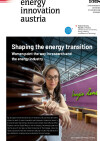
Women point the way in research and the energy industry
energy innovation austria
2/2024
Herausgeber: BMK in cooperation with the Climate and Energy Fund
Englisch, 12 Seiten
Downloads zur Publikation
50 Years International Energy Agency
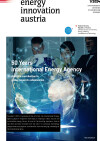
Austria’s contribution to global research collaboration.
energy innovation austria
1/2024
Herausgeber: BMK in cooperation with the Climate and Energy Fund
Englisch, 16 Seiten
Downloads zur Publikation
Sustainable Housing - Services creating individual and social advantages

Contemporary sustainable solutions for residential building will be optimised and realized by interdisciplinary planning orientated to the life-cycle services supporting the quality of life and intelligent use of information and communication technologies.
Conference: 19th European Biomass Conference and Exhibition
6. - 10. June 2011
ICC - International Congress Center Berlin
Berlin, DE
The 19th European Biomass Conference and Exhibition will take place in Berlin Germany (Conference: 6-10 June 2011 - Exhibition: 6-9 June 2011). The Technical Programme is coordinated by the European Commission, DG Joint Research Centre.
Development of a continuous hydrogen-carbon nanofibers production line
With the development of a hydrogen-carbon nanofiber production in a continuous process carbon nanofibers can be produced in an economic way and at the same time access to environmentally friendly hydrogen is enabled.
Information-point for renewable and environmental/ecological materials
An internet platform with full information and detailed data about building materials made of renewable resources, which serves as the central information-point for different stake holders - from private house builders over architects and master-builders to experts in the field of building laws and regulations.
Subjective housing quality as social acceptance test of sustainability
Post occupancy evaluation with residents of four low energy building projects and four conventional residential buildings in the city of Salzburg. (A co-operative project with the Workers Chamber of Salzburg and provincial research into residential building).
Innovations for the city of tomorrow
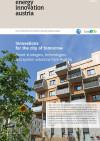
Smart strategies, technologies and system solutions from Austria
energy innovation austria
4/2016
Herausgeber: BMVIT und Klima- und Energiefonds
Englisch, 16 Seiten
Downloads zur Publikation
IEA HPT Annex 56 - IoT for Heat Pumps Final Results
18. October 2023, 9:30 am
online, AT
During this event you will have the opportunity to gain insights into the outcomes of the IEA HPT Annex 56, focusing on IoT (Internet of Things) and Digitalization for Heat Pumps.