
Suchergebnisse
Urban consolidation Lehen
The key project "Stadtumbau Lehen" ("urban consolidation Lehen") coordinates several projects at the urban district of Lehen, with the purpose of the raise in energy efficiency and safekeeping of a sustainable development. Four builder (ten teams of architects), two scientifically institutions, the town of Salzburg and two attended departments of the land are working together.
Virtual Green Power Plant
Preparation and initiation of the implementation of a Virtual Green Power Plant based on renewable energy sources at the Program Responsible Party of oekostrom AG - The conception of a power utility within the Austrian power market.
Energy-efficient army barracks

Holistic sanitation concepts for three selected army barracks belonging to the Austrian armed forces to achieve the standard of a low-energy house. An increase in energy efficiency and corresponding models for implementation agreed with large-volume buildings with due consideration to the special conditions prevalent within the Austrian armed forces.
IEA ES Annex 50: Prefab Systems for Low Energy/High Comfort Building Renewal
Development of integrated concepts for multi-storey buildings, which enable renovations of buildings with high energy efficiency at good user acceptance during the realisation phase as well as afterwards (comfort, affordability). Relevant components: integrated solutions of roof and façade with high rate of pre-fabrication, the possibility of integrating the energy façade/roofs and energy distribution and supply.
Binderfree Cellulose Compounds
Optimisation of weatherproof-performance (UV-protection and water-tightness) of binderfree cellulose compounds (incl. life cycle optimisation)
HY3GEN - A Regenerative Building
The "third generation hybrid building" (HY3GEN), whose main features are being defined in this project, has expanded this approach to include the integration of aspects of efficient resource utilization in construction and operation as well as the use of regenerative raw materials and renewable energy.
Investigation of the sustainable utilisation of carbon from methane pyrolysis
One of the possible alternative production routes for renewable hydrogen is methane pyrolysis. Compared to other, alternative production routes, methane pyrolysis has the lowest energy input (less than a quarter of water electrolysis) with a very high hydrogen yield.
Vertical Farm Aspern - Democratization of vertical farming under consideration of parameters of circular economy
Planning, construction and optimization of a vertical farm for urban food production, involving the users in the operational management. The building and the operator concept represent the entire food value chain, from planting to selling.
Circular Economy Funding
In this project, online research and expert interviews were used to collect available funding opportunities for projects and measures within the field of circular economy. The results were transferred to a database and organized for searches according to suitability.
Green SandboxBuilder - Regulatory sandboxes in the field of sustainable construction and renovation
In the "Green SandboxBuilder" project, for the first time in Austria, the need for regulatory sandboxes for ecologically sustainable and climate-effective projects in the building sector had been systematically explored. The implementation of regulatory sandboxes in the Austrian construction sector can contribute to decisively accelerating the introduction of technological, procedural and social innovations and thus to achieving the sustainability goals.
SocialLowCostFlex - Collaborative flexible low-cost energy supply concepts for social housing
This project aimed for feasible low-cost solutions, which allow residents of multi-party houses, with special focus on social housing to profit and participate in the energy transition process and associated trends (e.g. community generation units, exploitation of flexibility). The results of the project are low-cost concepts and business models of community generation units and utilization concepts, tested for their feasibility in a social housing complex. These concepts are based on special requirements of different lifestyles in low-income households and take the framework of social housing such as tenant fluctuation into account.
Net-Zero Cement: Building a Sustainable Future
19. March 2025
Online
The webinar is part of the Net-Zero Industries Mission (NIM) Industry Insights Series. Leading innovators and industry experts will showcase solutions, from alternative materials and carbon capture technologies to innovative production processes.
DigitalFindetStadt - Platform for digital innovations in the building sector
"Digital Findet Stadt" strengthens the digital innovation power of the Austrian building sector and thus contributes to a significant increase in resource, energy and cost efficiency.
GreEnergieausweis AT - Ways of integrating greenery into the Austrian Energy Certificate
Adaption of the calculation models in the energy certificate in such a way that the greening of buildings can be depicted as realistically as possible and assessment of the acceptance of implementation by relevant stakeholders.
ReHABITAT-Settlement: Sustainable rehabilitation and activation of a single-family housing estate in Mistelbach
Exploration of a sustainable single-family house redevelopment, with a holistically conceived definition of sustainability that starts with people, is based on sufficiency and also takes into account green and open spaces, social factors and mobility. The result is an integrated overall concept at the house and settlement level, and a transferable approach for other communities.
LZE 100 Lighthouse Objects - Long-term evaluation of the energy consumption of 100 energy-efficient buildings in Austria as a representative cross-section of Austrian lighthouse objects
Collection, evaluation and analysis of energy consumption data from 100 energy-efficient buildings in Austria over an operating time of 3 to 25 years as a representative cross-section of Austrian lighthouse objects. Differentiation according to building types, energy sources and determination of real greenhouse gas emissions. Comparison of the measured consumption to benchmark values.
EXPO HdZ: Best of Diffusion
Conception and implementation of measures to spread selected results from the house of the future - program to the building industry, in particular to meet the target groups architects, builders and building developers.
Comfort for sustainability
Research project on comfort and on the health and recreational value of passive houses
Pyrolysis technologies in Europe
Technology overview of medium-fast pyrolysis for decentralised applications, for small and medium-sized enterprises and for the circular economy
Austria's Way into the Future of Energy - Strategies and Success Stories (2019)
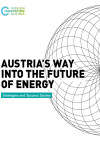
This broschure illustrates strategies and success stories from research & development for a sustainable energy future.
Herausgeber: Federal Ministry for Transport, Innovation and Technology, Climate and Energy Fund, Austrian Economic Chambers
Englisch, 68 Seiten