
Suchergebnisse
BIGMODERN - Subproject 10: Evaluation, Documentation and Ensuring Transferability
The subproject 10 is part of the flagship project BIGMODERN. It is based on the results of subproject SP 7 in which a monitoring concept has been developed. This concept is now implemented through monitoring of different aspects occurring during the first two years of operation of both BIGMODERN demonstration buildings.
aspern Vienna´s Urban Lakeside subproject 2: Inter-building energy distribution
Development of comprehensive concepts for local distribution systems for thermal and electric energy within a residential area including the consideration of the interaction with construction and city planning. Derivation of measures for demonstration buildings and the infrastructure of the residential area. Integration of computing models to a prototype simulating energy distribution in the residential area.
e3building - ecology, economy, efficiency: An International Network for the Entire Building Industry

Embedded in the EUREKA initiative PREPARE e3building serves as a network for the know-how exchange between building and construction industry, researchers and the funding programme on a national as well as an international level.
Measures for Minimisation of Rebound-Effects Concerning Residential Building Renovation (MARESI)
Development of a pragmatic assessment scheme applicable to building practice for the impact of building products on human health
Facilitated decision-making procedures for sustainable refurbishment of residential properties
Participation in the refurbishment process: Monitoring of concrete refurbishment projects and development of guidelines to optimise the planning, information and decision-making processes in the course of the refurbishment of residential properties
Bridging technologies on the way to a climate neutral future
New strategies for capturing and utilizing carbon dioxide
energy innovation austria
4/2017
Herausgeber: BMVIT und Klima- und Energiefonds
Englisch, 8 Seiten
Downloads zur Publikation
IEA Bioenergy Webinar Series: Integration of gasification processes in biorefineries
30. June 2022
Online, AT
A webinar on how gasification technology can be used in existing industries/biorefineries.
Multifunctional Energy Centre Kötschach-Mauthen - model-system to achieve energy-self-sufficiency
Development of concepts for a multifunctional Energy Centre (biomass district heating und biogas polygeneration for the supply of heat, electricity, process heat, cooling and biofuels) and for a "Öko-Energietourismus" for the community of Kötschach-Mauthen on the way to energy-self-sufficiency
Energy R&D 2023: Public Expenditures in Austria
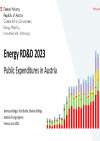
Public spending on energy research totalled 310.8 million euros in 2023. The figure for 2021, by far the highest ever recorded in Austria, was therefore exceeded.
Schriftenreihe
16/2024
A. Indinger, F. Bettin, M. Rollings
Herausgeber: BMK
Deutsch, 150 Seiten
Downloads zur Publikation
IEA Bioenergy Task 40: Deployment of biobased value chains (Working period 2022 - 2024)
Bioenergy Task 40 traditionally focused on international trade and supply chains of biomass for bioenergy. Starting in 2018, the systems view was broadened, also to better meet Austrian requirements. The supply chain focus was maintained, but with a broader premise: The establishment of bio-based value chains for a sustainable and fair bioeconomy.
IEA HEV Task 45 - Electrified Roadways (E-Roads) Workshop #5
09. - 10. October 2023
Södertälje, SE
In the bi-annual meeting the participating countries will gather information, gain first-hand knowledge of how this technology is progressing and identify specific areas that may be of critical interes for further research.
Energy Performance Contracting (IEA DSM Implementing Agreement - Task X)
The objective of this task within the IEA DSM programme is to facilitate the use of performance contracts and other energy service company (ESCO) contracts. In this scenario, the ESCO has taken on the project's performance risk by guaranteeing a specified level of energy savings. Its compensation for this risk is directly tied to achieving savings. The financing for such a project could come from the ESCO, the equipment supplier or a third-party company.
Modular and standardised passive houses in solid timber construction
Concerning to an accurate and adaptable construction of 2 to 4 storey solid timber houses with the characteristics of a passive house, a digital construction and dimension system will be developed. The system which contains standardised modular ecological detailed solutions enables an exact dimensioning and installation of passive houses by small carpentering companies.
Feeding Biogas Into The Austrian Natural Gas Grid
Analyses of technological, economic, and legal prerequisites as well as pilot projects within the "energy systems of tomorrow” subprogram
Forschungsforum
2/2006
Herausgeber: BMVIT
Englisch, 6 Seiten
Downloads zur Publikation
Single Family Homes and Densified Low-rise Housing - an Analysis of Motives
The study concentrates on describing the reasons behind the slow uptake of space-saving, densified forms of housing, and explains the dominant preference for detached single-family homes. However, it goes beyond simply describing the decisive motives for choices of housing. The study analyses the determining factors and the basic conditions under which these motives come or came into being. Based on this analysis, alternatives will be proposed and evaluated with regard to their effectiveness and feasibility.
built in 2020 - Pictures and stories of tomorrow for building in the future
Production of a comprehensive picture of tomorrow's building using research into future trends, the societal framework and political developments in the building sector.
PhaseOut – Heat pump technologies in the renovation of existing buildings
The aim is the conception, optimization, implementation, demonstration and evaluation of innovative, minimally invasive renovation solutions (thermal renovation and heating system replacement) with heat pumps and PV in multi-storey buildings on seven identical buildings. The comprehensive comparison includes various technical solution variants based on modular and scalable building technology systems as well as multifunctional building components for the exchange of decentralized gas heating by central, semi-central and decentralized heat pump solutions.
KLIMUR: climate-resilient urban resource management for the case study of Zukunftshof and Rothneusiedl
For the concept of the Zukunftshof, an innovative urban agriculture area, development scenarios for an integrated energy and resource cycle system are to be developed using optimisation tools and parametric design studies. A roadmap consisting of technical concepts and a coordinated financing strategy will provide the basis for a demo project that demonstrates in practice how the Zukunftshof can be the starting point and basis for resource-efficient and climate-resilient urban development.
SERECARB - SElective REcovery of Calcium CARBonate in paper sludge (SUSPRISE Joint Call)
Developing a new process based on selective recovery of calcium carbonate from paper mill effluents and sludge, purification, conversion into precipitated calcium carbonate (PCC) and reuse as filler in paper making.
LifeCycle Tower - Energy efficient prefabricated multi-storey timber houses
Based on the results of previous research projects, the project at hand deals with the development of a wooden prefabricated module construction for energy efficient office buildings with up to 20 storeys. This sustainable system ensures cost certainty through the whole life cycle of the building.