
Suchergebnisse
Fair market conditions for virtual power plants
Analysis of technical, economical and regulatory conditions to get fair terms under competition in the liberalised market for virtual power plants on renewable energy basis.
Development of a solid-wood-passivehouse-window
Based on experience with low-energy-windows, a solid wood window is being developed, which meets passivehouse-standards.
IEA FBC Implementing Agreement Fluidized Bed Conversion (working period 2020 - 2023)
The aim of the project is to continue to further develop the internationally very well accepted participation of Austria in the information network of the IEA Fluidized Bed Conversion (FBC) Technology Collaboration Programme (TCP) to optimize fluidized bed conversion of fuels applied to clean energy production (heat and power). All stakeholders will be included on a national as well as on a global level.
Innovative Energy Technologies in Austria: Market Development 2019
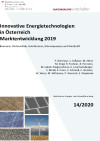
Biomass, Photovoltaic, Solarthermal collectors, Heat pumps and Wind power
14/2020
P. Biermayr, C. Dißauer, M. Eberl, M. Enigl, H. Fechner, B. Fürnsinn, M. Jaksch-Fliegenschnee, K. Leonhartsberger, S. Moidl, E. Prem, C. Schmidl, C. Strasser, W. Weiss, M. Wittmann, P. Wonisch, E. Wopienka
Herausgeber: BMK
Deutsch, 266 Seiten
Downloads zur Publikation
Circularity in the Clean Energy Transition - IEA EGRD Webinar
26. April 2021
Online
This webinar looked at the circularity of the clean energy transition from different angles: Challenges related to sourcing materials for renewable energy infrastructure, circularity in manufacturing processes and their durability and eventually disposal or reuse. These challenges were exemplified by a closer look at wind turbines and batteries.
Innovative Energy Technologies in Austria: Market Development 2020
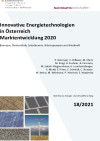
Biomass, Photovoltaic, Solarthermal collectors, Heat pumps and Wind power
18/2021
P. Biermayr, C. Dißauer, M. Eberl, M. Enigl, H. Fechner, B. Fürnsinn, M. Jaksch-Fliegenschnee, K. Leonhartsberger, S. Moidl, E. Prem, C. Schmidl, C. Strasser, W. Weiss, M. Wittmann, P. Wonisch, E. Wopienka
Herausgeber: BMK
Deutsch, 273 Seiten
Downloads zur Publikation
Workshop "Biorefineries on their pathway towards net-zero emissions"
7. November 2023
Online
The IEA IETS Task 11 workshop on "Biorefineries on their pathway towards net-zero emissions" collects case studies and methodologies from industry and research on how net-zero emissions can be achieved in biorefineries.
BIPV as Architectural Tool
15. June 2018
TU Wien, Getreidemarkt 9, 1060 Wien, AT
Within the international meeting of the IEA PVPS Task 15 "Enabling Framework for the Acceleration of Building integrated Photovoltaics (BIPV)", a workshop on "BIPV as Architectural Tool" is organized providing the opportunity to meet local PV-Architects and BIPV stakeholders.
IEA TCP Fluidized Bed Conversion (FBC). Working period 2013-2016
The Technology Collaboration Programme includes the collaboration, the exchange of relevant information and networking in the area of fluidized bed conversion of fuels applied for clean energy production.
M-DAB2: Material intensity of inner development - resource assessment and localization of urban development potentials
For the first time, the material intensity of inner development (in terms of material quantities) for different design variants was considered in the evaluation of inner development potentials. A set of methods for the holistic evaluation of potential areas and different development variants and scenarios for resource-saving inner development was created.
Renewables 2010 Global Status Report
Englisch, 80 Seiten
Downloads zur Publikation
Cascading Of Renewables
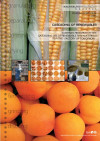
Austrian Research on the Cascading Use of Renewable Raw Materials for the "Factory of Tomorrow"
Forschungsforum
1/2005
Herausgeber: BMVIT
Englisch, 6 Seiten
Downloads zur Publikation
The Korean Energy Strategy Project (Minchener, 04-2008)
Englisch
Solar Heating and Cooling in Austria
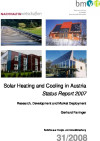
Status Report 2007
Research, Development and Market Deployment
Schriftenreihe
31/2008
Gerhard Faninger
Herausgeber: BMVIT
Englisch, 42 Seiten
Downloads zur Publikation
Whitepaper "Smart Grid Cyber Security"
M. Miller, D. Haglund, Gunhee Lee
Herausgeber: International Smart Grid Action Network (ISGAN) Annex 4, Subtask 3.4
Englisch, 16 Seiten
Downloads zur Publikation
Systemic renovation in the social housingsector
This project treats a global renovation of a residential estate built in the 1960s in the context of council housing in a laggard region. The point is to optimise with a systemic approach in a interdisciplinary team all partitions which include habitation.
Workshop: Life in the Fast Lane - Evolving Paradigms for Mobility and Transportation Systems of the Future
26. - 27. October 2016
Washington, DC
A Workshop to Determine Research & Development Needs and Supporting Policies.
IEA SHC Conference and ISES Solar World Congress 2017
29. October - 2. November 2017
Jumeirah Hotel at Etihad Towers, Abu Dhabi, United Arab Emirates (UAE)
The International Solar Energy Society, ISES, and the International Energy Agency’s Solar Heating and Cooling Programme, IEA SHC, are very pleased to announce that their next international conferences, the ISES Solar World Congress 2017 (SWC 2017) and the Solar Heating and Cooling for Buildings and Industry Conference (SHC 2017) will be held together.
IEA FBC Implementing Agreement Fluidized Bed Conversion (working period 2017 - 2020)
The technology programme includes the collaboration, the exchange of relevant information and networking in the area of fluidized bed conversion of fuels applied for clean energy production.
5th European Bioplastics Conference
1. - 2. December 2010
Hilton
Düsseldorf, DE
Latest technological and market developments