
Suchergebnisse
OPEN LIVING PLUS - building structures and utilization options with high social functionality and plusEnergie-standard for rural regions
In small to medium sized communities in rural Regions there is a high demand for sustainable building and space for innovative living facilities, to satisfy the requirements of current and coming life designs. The project’s intentions were to provide social scientific groundwork, develop building structures and utilization options of high social functionality and to transfer knowledge to decision makers in communities and regional authorities.
Beacon of innovation gugler cross media, ecoeffective zero energy cross media enterprise featuring zero-emission, zero energy, zero waste
The aim of the flagship project is a new dimension of sustainability (cradle to cradle, ecoeffective zero energy enterprise) for business operation and building, which means zero emission, zero energy, zero waste. This will be shown on the basis of a beacon of innovation: Gugler GmbH, a modern sustainable media services enterprise (traditional print and new media) will extend their current building from about 2100 square meters and about 90 employees to about 5,000 square meters.
The "Schiestlhaus" In The Hochschwab Region - Alpine Refuge Using Passive House Technology
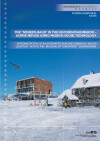
Implemantation of an integrated building design in "Island Location" within the "Buildng of Tomorrow" subprogram
Forschungsforum
2/2005
Herausgeber: BMVIT
Deutsch, 6 Seiten
Downloads zur Publikation
An analysis of the factors supporting and hindering the market penetration of innovative residential buildings
An empirical analysis of the most important factors in supporting or hindering the market diffusion of selected technologies or different innovative residential concepts.
Ventilation and heating in passive houses: Comparison of variants in terms of thermal comfort and sustainability
This projects aims at systematic resarch on thermal comfort and the sustainability of heating passive houses with and without air heating. The results of the comprehensive investigation of different variants will provide valuable information for building developers, planners and for funding decisions.
Inter-linked design as a strategy towards sustainable buildings - removing deficiencies of learning and of diffusion
The aim is to investigate the role of inter-linked design team organisation in the design of sustainable buildings and to formulate ready-to-use recommendations and guidelines for dissemination.
Participation in CEN TC 350 (sustainability of construction works) - WG4 Economic Performance Assessment of Buildings
Participation in the CEN TC 350/WG4 to develop a standard to evaluate the integrated effectiveness of buildings during their life cycle. Evaluation and integration of national comments in order to prepare the standard for the final vote.
KELVIN - Reducing the urban heat island effect via improving the reflective properties of buildings and urban areas
The aim of this project was to estimate the potential to reduce urban heat islands via low-tech measures such as the variation of the surface albedo, using the City of Vienna as an example. The project has also assessed the energy savings and greenhouse gas emission reductions due to the decreased energy demand for cooling as a result of such measures.
EnergieAudioAkademie - Development and usage of audiofiles for the training of professionals from the building sector
Important issues in building energy efficiency will be prepared as audio files. The target groups are builders and plumbers. The files complement existing training and educational programs and will be disseminated via CDs and/or USB sticks to the target groups via craftsmen networks and an internet platform.
ProKlim+ - Use of Model Predictive Control to optimize solar power consumption in case of increased energy efficiency.
Using weather forecast for building automation can help improving the energy efficiency of buildings and, thus, saving energy. In the project ProKlim+ the forecast of solar radiation will be used to optimize the building automation to satisfy the needs of the building users, and at the same time to minimize the energy demand on the one hand and to maximize the consumption of self-produced energy on the other hand.
Refurbishment of an existing villa of the "Gründerzeit" to passive house standard with passive and active solar use
The project shows in an exemplary way how buildings of the time of "Gründerzeit" could be maintained and could offer a better environmental balance including the view of the village and the traffic than a new building. As an example a villa has been converted into a multi-family house within a larger housing project.
Online reference for ecologically rated building construction details suitable for achieving Passivhaus standard
An already well-established web database management system is being adapted to present the contents of a catalogue of building elements for the Passivhaus standard. A wider distribution of the contents and future extensions of the catalogue by distributed workgroups are the promises of the project.
Thermocollect - Solar active facade system, using direct solar radiation for temperature conditioning of buildings
The new Thermocollect Energy-Facade System allows to utilize the solar radiation that hits the facade on a on-demand-basis. The system works with a mechanically active mechanism which selectively gathers the solar radiation and additionally can be used as a cooling and heating system according to the local requirements.
Sustainable ventilation systems in multi story residential buildings in the conflict areas of hygiene and costs
The goal of this project was to develop guidelines for hygienic and cost-efficient mechanical ventilation systems in residential buildings, in which maintenance and cleaning demands are described. These guidelines are based on existing literature as well as practical experience of the property owners, finally they are based on results of hygienic measurements in existing ventilation systems conducted in this research project.
Potential and concepts for waste water heat recovery in combination with solar collectors and heat pumps (WRGpot)
The objective of the project is to find possibilities for the reduction of heat demand for hot water preparation of low energy and passive house buildings, in order to advance a further step into the direction of plus-energy buildings.
SaLüH! Renovation of multi-family houses with small apartments, low-cost technical solutions for ventilation, heating and hot water
New innovative concepts for heating and ventilation were investigated. Very compact heat pumps are developed in such a way that it will be possible to integrate these units into the window parapet or into a prefabricated timber façade.
Investigation into control systems for low emission, high efficiency biomass furnaces for heating residential and office buildings.
Through optimising the control systems of biomass heating systems, energy wastage and pollutant emissions can be reduced considerably. The goal of the project is first to analyse the possible savings that can be made in these areas, using the heat demand scenarios of different "Buildings of Tomorrow". The results of this analysis will lead to the development of an optimised control system which will be tested on a biomass heating system.
The very first reconstruction in Austria of a one-unit house to passive house standard (Model project in Pettenbach/Upper Austria)
The main objective is the unprecedented reconstruction of older one-unit buildings to the standards of passive houses. The reconstruction estates are of the numerous older one-unit houses in Austria. The reconstruction will considerably enhance the convenience of living quarters in the old houses.
SIMULTAN - Simultaneous planning environment for buildings in resilient, highly energy efficient and resource-efficient districts
This project enabled the opportunity for an essential energy efficiency increase within overlapping buildings, to achieve the objective of resilient cities and districts with respect to a high quality of life, resource sustainability and energy efficiency. The goal was a workable tool based on a multidisciplinary planning approach, to support the decision finding process in order to design both refurbishment projects and new developments within a highly efficient city.
SynENERGY - Energy optimised settlement development by making use of synergies of energy efficiency, spatial planning and building culture
SynENERGY aims at an innovative, holistic approach to urban district optimization. The project targets a comprehensive analysis of the framework and urban development concept which includes not only optimisation of sustainable energy supply and use but also increased material flows (construction and disposal) at urban district level.