
Suchergebnisse
Sustainable Housing - Services creating individual and social advantages
Contemporary sustainable solutions for residential building will be optimised and realized by interdisciplinary planning orientated to the life-cycle services supporting the quality of life and intelligent use of information and communication technologies.
Information-point for renewable and environmental/ecological materials
An internet platform with full information and detailed data about building materials made of renewable resources, which serves as the central information-point for different stake holders - from private house builders over architects and master-builders to experts in the field of building laws and regulations.
Subjective housing quality as social acceptance test of sustainability
Post occupancy evaluation with residents of four low energy building projects and four conventional residential buildings in the city of Salzburg. (A co-operative project with the Workers Chamber of Salzburg and provincial research into residential building).
openVALUE - Quality and Weight of Open Spaces of Urban Building Projects
Based on four case studies the comprehensive contribution of open space to the increase of quality in real estate development was presented and provides the basis for the development of application oriented measures of quality management and strategies for innovative solutions.
e80^3-Buildings - Sub project 3: Development of technology and components
The main objective of the key project "e80^3" was to develop high-performance renovation concepts focusing on plus-energy-buildings. Afterwards these concepts were realized in at least one or two demonstration-projects.
OptoControl - Modern sensor systems for energy conservation in buildings
The necessary efficiency of modern energy-self-sufficient buildings can only be achieved with intelligent control of the key parameters. The main focus of the project is the adaptation of optical sensor concepts for application in building technology. The future goal of the project is to supply the modern energy-plus-house with an appropriate and intelligent control device to minimize energy loss.
Research work on outside sprayed-on cellulose insulation covered with plastering
This research work was done to expand knowledge about outside sprayed-on cellulose insulation application focusing on mechanical and physical properties respectively.
Recommendations for a consolidated Austrian research in the topic of "Smart Cities"
Based on a clear definition of the topics and focusing on energy relevant aspects the project will provide an overview on the present points of focus in research on "Smart Cities". Furthermore, future research topics will be defined and evaluated, and action plans for political stakeholders will be elaborated in the framework of two expert workshops.
3D*3B - 3D-Concret Printing, Reinforcement for low carbon and bending stressed structures.
The project is about 3D printed structural elements and their integration in building structures. The focus is predominantly set on bending stresses structural elements like panels and slabs. Results will point out technical, logistic and climate relevant aspects.
BIM4BIPV - Future aspects of building-integrated photovoltaics (BIPV) in cross-system BIM planning
Research into an end-to-end BIM planning flow for energy-optimised, building-integrated photovoltaics (BIPV) that simultaneously generates solar energy, enables optimal use of daylight and provides shading.
PassiveHouseDataBase - International Passive House and Passive House Plus Database
About 3.000 buildings are documented, all of them show a high level of comfort and follow energy and building technique standards for passive houses and plus-passive houses. By integration of object and evaluation data, the database will become the worldwide basis for extremely energy efficient buildings and because of its multilingualism and quality assurance opens up new sustainable export possibilities.
Stroh-Cert: certification, logistic and quality management for straw bale buildings
Certification of straw bales as insulating material, development of a straw bale logistic concept and a quality management system as strategic measures with the aim of the dissemination of straw bales as insulating material
Pallets never pall - Development of the Pallet House to series-production readiness
The winning project "Pallet House" of the EU-wide competition GAU:DI in 2007 consists of 800 (used) pallets. It has been exhibited in a scale 1:1 at the Biennale in Venice 2008 and has been developed for mass production within this project. Therefore, two exemplary scenarios were developed: (temporary) construction at Vienna's Urban Lakeside in Aspern and the construction of a low-cost building in South Africa.
baubookPlus - Expansion of an extensive knowledge database of sustainable buildings
By the foundation of the baubook GmbH in 2008 the two databases of building products "öbox" and "ixbau.at" have been merged. The new database baubook was expanded. Essential functions (central product declaration, decentral quality management) and fields of products were added.
Analysis and evaluation of structural additional costs for passive house projects
Structural extra costs of passive houses decide whether these will become accepted at the market. Within the project the costs of several "Building of tomorrow" passive houses were compared. The results enable estimations for future passive house projects.
BIGMODERN - Subproject 4: Life-cycle cost analysis (LCCA) during the planning process
Creation of technical and organisational preconditions for constructors to integrate life-cycle cost analysis (LCCA) already into the planning process. Furthermore, the findings will be applied within the two demonstration projects of the flagship project BIGMODERN (SP2 and SP3). The publication of fundamental results makes conceptive basics and LCCA-results available for all stakeholders in the real estate industry.
Walchfenster04 - from a functional model to a serial production-oriented prototype
Technical preparation of the functional model from the window and facadesystem walchwindow04 to a serial production-oriented prototype. Developing the new production processes and technologies
Competition for prefabricated house producers to design types of attached houses
A competition for the builders of prefabricated houses provided new design-types of attached houses. The results have been awarded and published to encourage the participants to enter this segment of the market.
Transfer conference "Alpine hut of Tomorrow" pilot project "Schiestlhaus"
The aim of the event was an open in-depth discussion with and for experts of the alpine clubs in order to evaluate the pilot project "Schiestlhaus" and to identify usable approaches for sustainable buildings in the alpine area.
Facade-Integrated Thermal Solar Installations
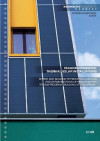
System and building physics fundamentals and implementatio of results within the subprogram "Building of Tomorrow"
Forschungsforum
3/2001
Herausgeber: BMVIT
Englisch, 6 Seiten