
Suchergebnisse
IEA HPT Annex 61: Heat Pumps in Positive Energy Districts
IEA HPT Annex 61 evaluates the role of heat pumps (HP) in positive energy districts (PED). Efficiency potentials of the electric and thermal energy of districts that can be unlocked with the use of HPs are evaluated in order to reach a positive energy balance. This refers to both, upgrade of waste heat and simultaneous generation of different energy use in buildings (space heating, DHW, space cooling/dehumidification) and includes self-consumption of on-site renewable electricity generation.
IEA HPT Annex 60: Retrofitting Heat Pump Systems in Large Non-domestic Buildings
Lack of knowledge about retrofit options with heat pumps currently hinders the widespread use of the technology in non-residential buildings. In this project, easy-to-use, accessible recommendations for techno-economically optimised planning / design of heat pump applications in hospitals, shopping centres, industrial buildings, educational institutions, and museums will be developed and communicated to relevant target groups in the form of guidelines and training courses.
IEA EBC Annex 63: Implementation of Energy Strategies in Communities
As part of the "Annex 63" project, Austria has worked with 10 other countries to develop guidelines for the successful implementation of energy strategies at local level. The results include support for nine strategic measures, descriptions of case studies, support materials and recommendations for different target groups.
World Energy Outlook 2014

Herausgeber: International Energy Agency (IEA), ©OECD/IEA 2014 World Energy Outlook, IEA Publishing
Englisch, 748 Seiten
Net Zero Energy Buildings
International Projects of Carbon Neutrality in Buildings
Voss K., Musall E., et al.
Herausgeber: München 2011 (Internationale IEA Publikation)
Englisch, 40 Seiten
IEA-4E Jahresbericht 2014

IEA Implementing Agreement for a Co-operative Programme on Energy Efficient
End-Use Equipment (4E)
Herausgeber: 4E
Englisch
Downloads zur Publikation
The IEA Bioenergy Annual Report 2006
Of the available biomass conversion technologies for production of more usable energy forms, fast pyrolysis is the least developed, but offers the benefits of a liquid fuel with concomitant advantages of easy storage and transport as well as higher power generation efficiencies than fossil fuelled systems at the smaller scales of operation that are likely to be realised from bioenergy systems.
Englisch
Energy efficiency in industry
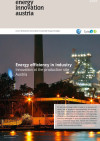
Innovation at the production site Austria
energy innovation austria
3/2013
Herausgeber: BMVIT
Englisch, 8 Seiten
Downloads zur Publikation
IEA AMF - Newsletter 2/2013

Herausgeber: International Energy Agency - Advanced Motor Fuels
Englisch, 14 Seiten
Downloads zur Publikation
IEA-4E Jahresbericht 2015
Herausgeber: IEA - 4E
Englisch, 39 Seiten
Downloads zur Publikation
IEA-4E Jahresbericht 2013
Der Jahresbericht umfasst die wichtigsten Errungenschaften des Jahres 2013, sowie eine Zusammenfassung der Aktivitäten der einzelnen 4E Annexes.
Herausgeber: IEA 4E
Englisch, 46 Seiten
Downloads zur Publikation
The IEA Bioenergy Annual Report 2005
Bioenergy is increasingly utilised to reduce emissions of greenhouse gases (GHG). Various options exist for trading bioenergy and bioenergy services between countries.
Englisch
IEA-SHC Task 66: SOLAR ENERGY BUILDINGS - Integrated solar energy supply concepts for climate-neutral buildings and communities for the "City of the Future”
The energy supply for climate-neutral buildings is based on holistic system concepts that achieve high renewable fractions by intelligently combining technologies, sector coupling, high grid interaction and flexibilization measures. The Solar Energy Buildings Task supports exactly this development. The objective is to identify relevant stakeholders and their needs, to develop a technology portfolio and optimised integrated energy concepts and to give recommendations to policy makers and energy-related companies.
IEA AMT Task 12: Novel 2D materials and laser-based surface processes to increase resource efficiency in mobility applications
Friction and wear cause enormous global costs and CO2 emissions. At the same time, machines should become more and more reliable. Within Task 12, new concepts in material development and surface processes are being examined and advanced in order to reduce friction and wear.
IEA HPT Annex 50: Heat Pumps in Multi-Family Buildings for Space Heating and DHW
The project aims at demonstrating the potentials of heat pump technology for the energy supply of multi-family houses (MFH) and to contribute to the elimination of existing market barriers. Concepts and innovative technology options for heat pumps in MFH will be investigated in detail by means of simulations and experiments. The findings and results will be presented in international expert meetings and disseminated among national heat pump manufacturers, installers and planners.
IEA-GHG Overview 2012

Herausgeber: International Energy Agency - Greenhouse Gas R&D Programme
Englisch, 160 Seiten
Downloads zur Publikation
IEA PVPS Task 1: Strategic PV Analysis & Outreach (Working period until 2022)
This task, which is mandatory for all countries participating in the IEA-PVPS program, has been producing global reports on photovoltaic development since 1993. In addition, content-related priorities are set, or new topics and tasks are developed, which are then sent to the ExCo for decision-making. This gives Task 1 strategic importance for the overall IEA PVPS program.
IEA EBC Annex 55: Reliability of Energy Efficient Building Retrofitting - Probability Assessment of Performance & Cost (RAP-RETRO)
The scope of the project is to develop and provide decision support data and tools for energy retrofitting measures. The tools will be based on probabilistic methodologies for prediction of energy use, life cycle cost and functional performance. The impact of uncertainty on the performance and costs will be considered. Methods based on probability give powerful tools that can provide us with reliable ranges for the outcome.
IEA-DHC Annex TS2: Implementation of Low Temperature District Heating Systems
The potential of alternative heat sources is highest at low system temperatures, but current district heating networks are usually high-temperature systems. The aim of the IEA DHC Annex TS2 is to support the transformation of district heating networks towards lower temperatures (the so-called 4th generation). For this purpose, Annex TS2 forms an international platform that enables an exchange on the topics of technology, system, demonstration and competitiveness.