
IEA HPT Annex 61: Heat Pumps in Positive Energy Districts
Short Description
The building sector plays a central role in reducing CO₂ emissions and achieving climate protection goals. In particular, neighborhoods offer significant potential for increasing efficiency, as synergies can be leveraged at both the thermal and electrical levels through coordinated solutions for different building uses and load profiles. In IEA HPT Annex 61, concepts for integrating heat pumps into Positive Energy Districts (PED) were developed, optimized in simulation studies, and verified through the investigation of demonstration projects.
The overarching goal of the project was to evaluate various integration options for heat pumps in PED and to demonstrate their contribution to achieving a positive energy balance. Building on the findings of the previous IEA HPT Annex 49 on the integration of heat pumps in Nearly Zero Energy Buildings (nZEBs), strategies were developed to unlock efficiency potential at the building and neighbourhood levels.
The project results underline that PED can transform buildings from mere energy consumers into active components of the energy system, even though achieving a net-positive energy balance in urban areas remains a significant challenge, i.e., PED should be understood more as a vision than a technical objective. Heat pumps prove to be a key technology for sector coupling, as they connect heating and cooling needs with electricity generation and enable the integration of renewable energies.
Various stakeholders—from manufacturers and policymakers to planning and construction companies—are collaborating on the development of innovative concepts for PED. The insights gained provide an important foundation for the further development of components and system solutions, for political strategies for the energy transition at the district level, and for the practical implementation of ambitious energy and emissions targets.
To address the research questions, the project was divided into five work packages:
- T1 – State of the Art: The current state of development of heat pump applications in PEQ was analysed based on comprehensive literature reviews.
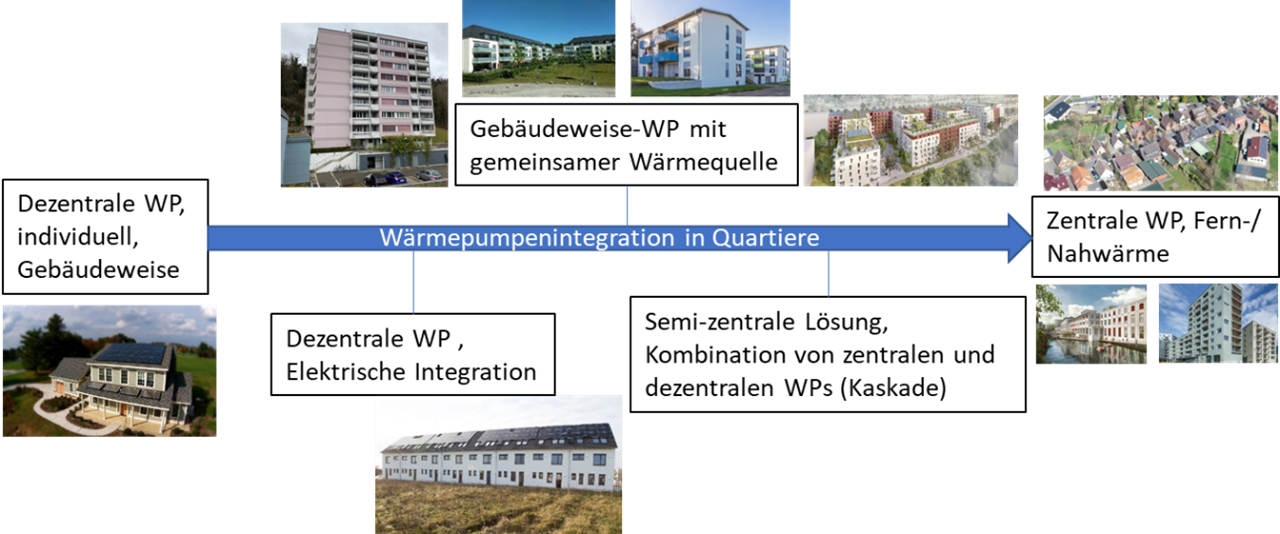
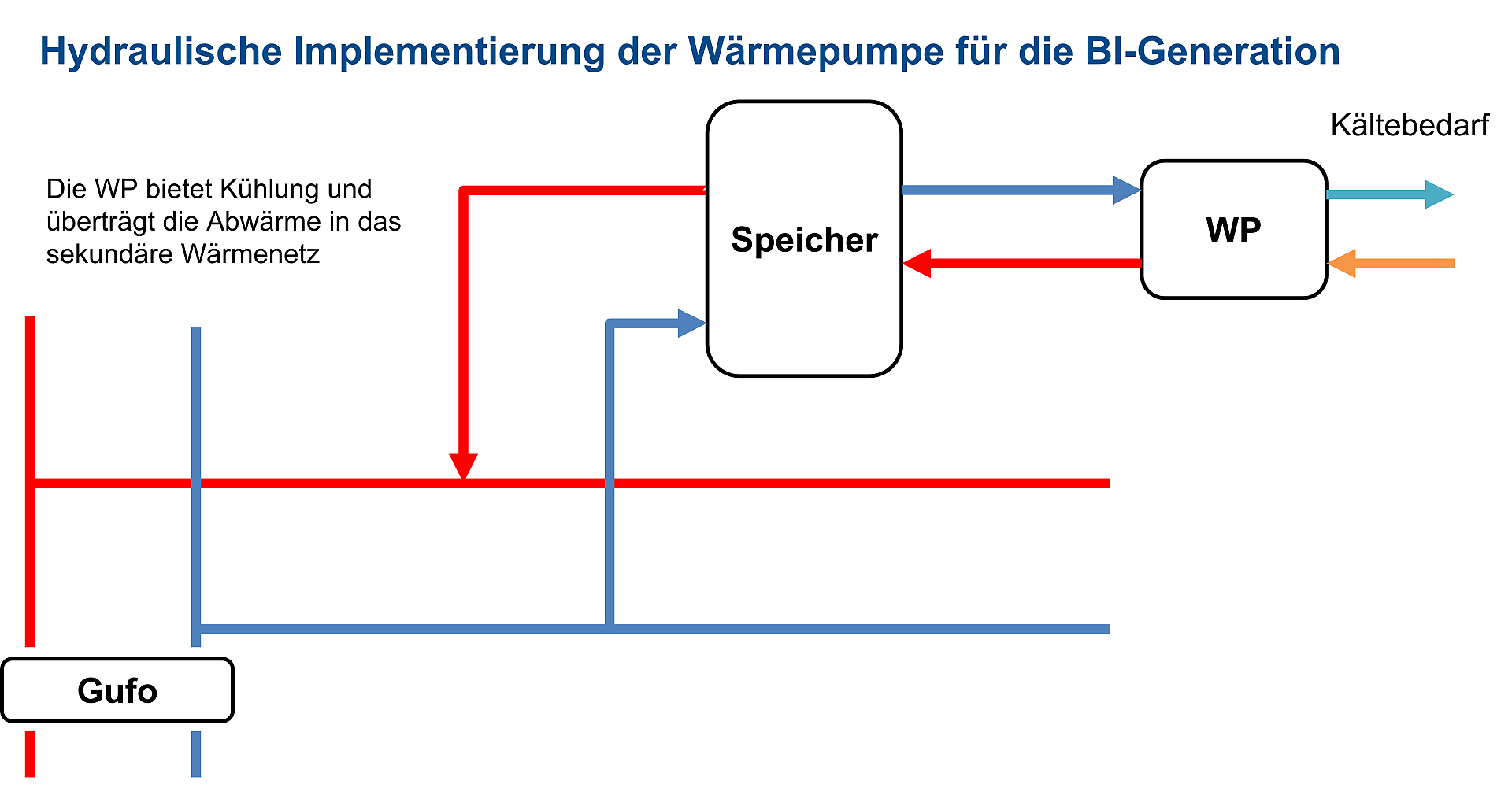
- T2 – Development of Heat Pump Concepts: Different heat pump system topologies at building and district levels were evaluated using simulation-based analyses.
- T3 – Technical and Economic Evaluation: Techno-economic analyses, with a particular focus on heat pumps in district heating systems, revealed the advantages of decentralized and semi-centralized systems.
- T4 – Performance Evaluation of Real-World Heat Pump Systems: The technical evaluation of large-scale heat pumps was carried out using refrigeration cycle simulations. In addition, the results of monitoring various national and international real-world installations were analysed.
- T5 – Dissemination: The project results were made available to a broad scientific and technical audience through scientific publications, conference presentations, and national and international workshops in cooperation with other IEA projects such as IEA HPT Annex 62, IEA SHC Task 66 and IEA EBC Annex 83.
Overall, the project made significant contributions to the understanding and further development of heat pump solutions in PED. The results show that heat pumps represent a crucial component for climate-neutral districts and future sustainable energy systems. Further development of integrated planning tools and the implementation and documentation of further PED projects should be next steps.
Project Images
Terms of use: The pictures listed underneath the header “Project Pictures” originate from the projects in the frame of the programmes City of Tomorrow, Building of Tomorrow and the IEA Research Cooperation. They may be used credited for non-commercial purposes under the Creative Commons License Attribution-NonCommercial (CC BY-NC).
Publications
Participants
Austria, Italy, Germany, Japan, Switzerland (Operating Agent), the USA
Contact Address
Fabian Ochs
University of Innsbruck
Institute for Construction and Material Science
Unit Energy Efficient Building
Technikerstraße 13, 5. Stock, A-6020 Innsbruck
fabian.ochs@uibk.ac.at
Christoph Reichl
AIT
Giefinggasse 2, 1210 Vienna, Austria
christoph.reichl@ait.ac.at
Gerald Zotter
AEE INTEC
Feldgasse 19, 8200 Gleisdorf, Austria
E-Mail: c.rohringer@aee.at