
Suchergebnisse
GLASGrün - Regulation of climate, energy demand and comfort in GLASS buildings through structurally integrated vertical GREEN
Development of vertical vegetation systems for summergreen shading of glass facades of food retail and commercial areas. GLASGrün generates quantitative data on energy and microclimate balance and qualitative data on user perception. The results are guidelines for scalable and transferable constructive solutions with maintenance and management plans.
GreenDeal4Real - Improving the thermal comfort in mixed-use areas through cost-effective green infrastructure
In Vienna's 22nd district, a mixed-use construction project was used as an experimental space to simulate the effects of green structures and analyse their implementation in a real planning environment. The simulations, the planning laboratory and close cooperation with the developer made it possible to take microclimatic effects into account as early as the planning stage and to optimally compensate for the negative effects of additional sealing through greening.
sustAIn4Build - AI competence for sustainable building management in climate neutral cities
The objective of the project sustAIn4Build is to increase energy efficiency and sustainability in the building sector by using artificial intelligence (AI). Industry-specific training programs support Austrian companies to develop a workflow for integrating AI technologies into their processes, enabling them to develop resource-saving, cost-effective and sustainable solutions. This strengthens their competitiveness and contributes to the achievement of European decarbonisation goals.
Fit4Klim - Fit through education for the climate
The aim of the project is to develop and test customised training courses to qualify cities and municipalities in the areas of climate change adaptation and climate protection, spatial planning, green finance, energy and mobility.
Flucco+ - Flexible user comfort in quarter-hourly CO2-neutral Positive Energy Districts (PED)
The aim of the project is to improve the planning basis for the construction and operation of energy flexible buildings in three specific areas. First the further development of existing models of thermal comfort for dynamic situations, second the quantification of future energy grid usefulness and third the holistic testing of the developed comfort and CO2 model at three potential positive energy districts (PED), taking into account the ecological assessment as well as the life cycle costs.
SmartControl - Standardized and smart control of municipal energy systems
The aim of the project is to develop a standardized and easy-to-implement procedure for communication, monitoring and control of decentralized technologies within municipal energy communities. Therefore, innovative interfaces and self-learning algorithms will be developed, which will ensure that the concept can be transferred to municipalities or neighborhoods without a great deal of data and measurement effort.
Wiener Neustadt Climate neutral
Wiener Neustadt as a pioneering city, is making a conscious and ambitious transition towards climate neutrality. This complex transformation requires different measures. The measures shall both be developed in-house or developed by others and transferred to Wiener Neustadt. The effect of the entire bundle of measures from the different areas (e.g. governance, implementation districts, learning environment or energy, mobility, buildings, etc.) is subject to fact-based climate monitoring.
Climate Pioneer City Graz (KPS_Graz)
As an integral part of the ongoing Climate Change Mitigation Plan Graz process, the Climate Pioneer City Graz project with the Federal Ministry for Climate Action, Environment, Energy, Mobility, Innovation and Technology (BMK) will make a noticeable contribution to ensuring that the planned local processes and measures to achieve climate neutrality are implemented more quickly. This will be achieved primarily through the financing of additional climate protection experts in the city administration.
Climate neutral Wiener Neustadt 2040
Wiener Neustadt wants to develop its own vision and implementation strategy for climate neutrality by 2040 and develop it in four steps.
BIOCOOL - Bio-inspired Surfaces for the Evaporation Cooling of Building Envelopes
The BIOCOOL project will explore the transfer of morphological principles from leaves of deciduous trees, with optimized thermal properties and efficiency of evaporation to the parametric design of form-optimized architectural ceramic surfaces for climate control of building envelopes. The study paves the way for an industrial research project.
Sozial100%Erneuerbar: 100% renewable heating and cooling supply in social housing - the demonstration project Käthe-Dorsch-Gasse
100 % renewable (on-site) heating and cooling supply in social housing while achieving good living comfort. Implementation, monitoring and optimisation of an overall heating and cooling system that has not yet been implemented in this combination (especially in social housing).
LOW TECH innovation-lab - real laboratory for the transformation to climate and resource-saving energy regions with innovative LOW TECH solutions
LOW TECH innovation-lab aims to set up an innovation laboratory in which innovative model solutions are developed, tested and widely rolled out in cooperation with suitable pilot regions on the basis of an optimized approach with regard to the use of technology on the one hand and the potential of the circular economy, local environmental resources and social innovations on the other.
CoolAIR - Predictive control of natural nighttime ventilation and daylight-optimized shading for passive building cooling
Natural nighttime ventilation and daylight-optimized shadowing are high potential approaches to efficiently and economical cool buildings. Nevertheless, the full potential cannot be acquired, since, if at all, such behavior is manually initiated by users. Goal of this project is the development of an automated, self-learning system that can assess the full cooling capabilities and establish an alternative to conventional air conditioning systems.
Ice-storage NEW - New economical ice storage concept for optimized heat storage using heat pumps and peak use of wind power
Development of a technically and economically optimized new ice-storage concept as a thermal wind power peak storage and to improve the performance of heat pumps as a contribution for peak smoothing of the electrical load profile.
Climate neutrality roadmap St. Veit/Glan
St. Veit/Glan aims at advancing to a beacon for other small Austrian towns by developing strategies, measures and for building the capacity, necessary for achieving climate neutrality by 2040.
Folder: Innovative nature based solutions for greening cities
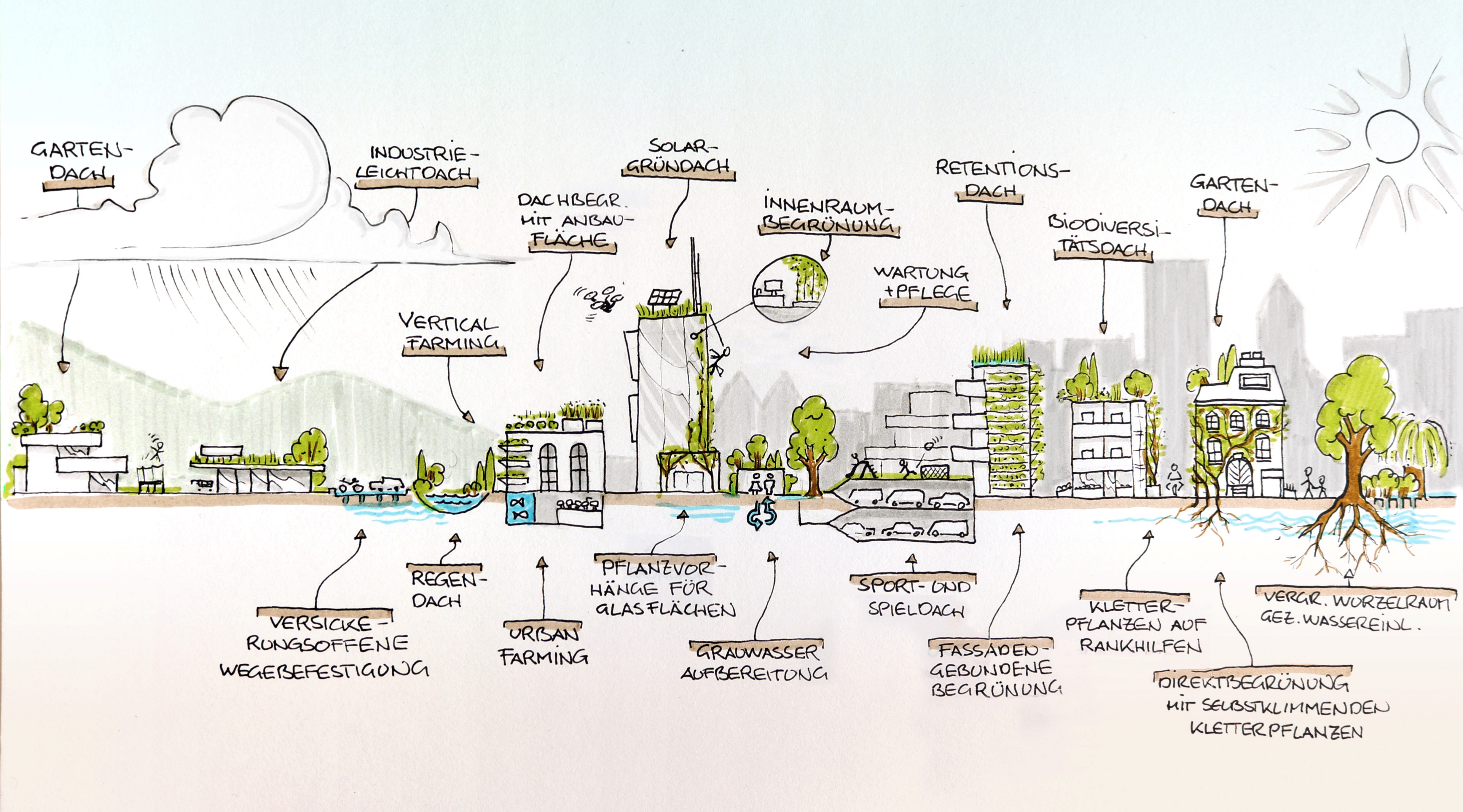
Densely built-up areas, the associated soil sealing and a lack of green spaces are enormous challenges in times of climate change. The folder shows a variety of ways in which innovative greening technologies can help cities adapt to climate change.
Herausgeber: BMK (2020)
Mehrsprachig, 2 Seiten
Downloads zur Publikation
Urban cooling demand in Austria 2030/2050 (UKÖ 2030/2050)
Systematic processing of the increasing cooling demand and presentation of the geographical location of the cooling demand in Austria. The result serves as a decision-making aid for the development of climate protection measures and climate change adaptation strategies as well as an estimate of future cooling demand.
ERA-NET COFUND Smart Cities and Communities (2014 - 2019)
Smart Cities and Communities have been identified as key to achieving the energy efficiency targets for 2020 and 2050. The main objective of this ERA-NET COFUND is to stimulate successful practice and facilitate replicability within Smart Cities and Communities implementation projects and also across projects in order to achieve a technological shift in the current energy system and provide smart and integrated solutions for technology, government and society.
Energy-storage concrete: Thermal Component Activation
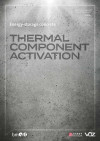
This planning guide provides information on the option of solely heating and cooling small-volume residential buildings by means of thermal component activation (TCA). Concrete instructions on the planning of residential buildings with thermally-activated ceilings are also provided.
Felix Friembichler, Simon Handler, Klaus Krec, Harald Kuster
Herausgeber: BMVIT
Englisch, 122 Seiten
Downloads zur Publikation
Highlights of Energy Research 2021 "Energy storage - key element to energy transition"
23. November 2021, 9:30 – 15:00 Uhr
Online Livestream
The event “Highlights of Energy Research” this year focused on the topic “Energy storage”. Activities of the IEA Energy Storage TCP, the market analysis of energy storages in Austria as well as various research projects were presented, which covered a wide range of topics from battery development to large-scale heat storage and sector coupling.