
Search Results
Austria’s cities as innovative leaders
Austria’s cities as innovative leaders in climate action and sustainable development.
Publisher: BMIMI in cooperation with the Climate and Energy Fund
English, 12 pages
Publication Downloads
Folder: Innovative nature based solutions for greening cities
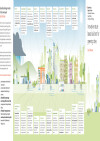
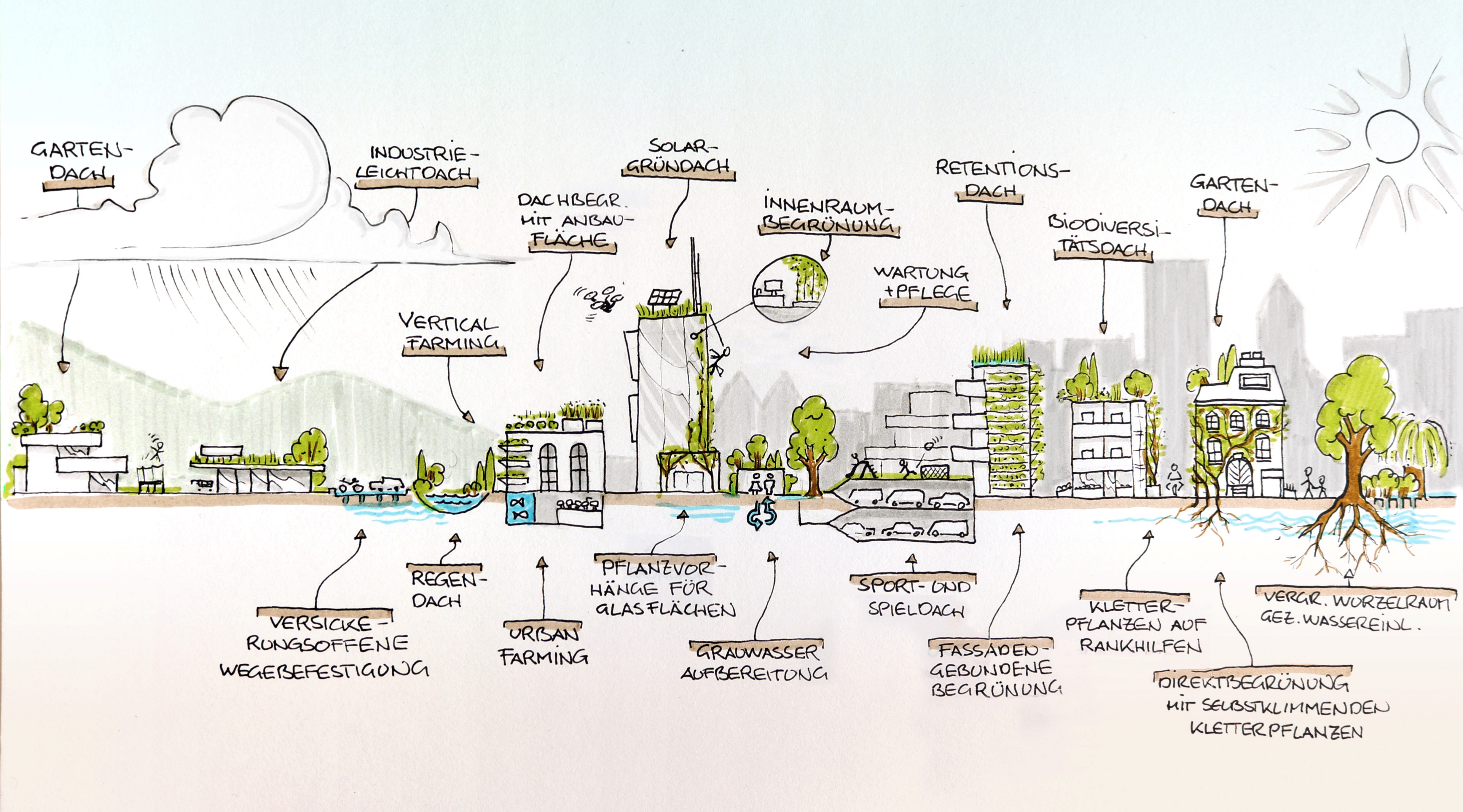
Densely built-up areas, the associated soil sealing and a lack of green spaces are enormous challenges in times of climate change. The folder shows a variety of ways in which innovative greening technologies can help cities adapt to climate change.
Publisher: BMK (2020)
Multilingual, 2 pages
Publication Downloads
Urban cooling demand in Austria 2030/2050 (UKÖ 2030/2050)
Systematic processing of the increasing cooling demand and presentation of the geographical location of the cooling demand in Austria. The result serves as a decision-making aid for the development of climate protection measures and climate change adaptation strategies as well as an estimate of future cooling demand.
Energy-storage concrete: Thermal Component Activation
This planning guide provides information on the option of solely heating and cooling small-volume residential buildings by means of thermal component activation (TCA). Concrete instructions on the planning of residential buildings with thermally-activated ceilings are also provided.
Felix Friembichler, Simon Handler, Klaus Krec, Harald Kuster
Publisher: BMVIT
English, 122 pages
Publication Downloads
Evaluation of visionary architectural concepts
The aim of this project is to show that even at first glance unrealistic and seemingly unworkable solutions can contribute to overcome or mitigate increasingly global problems. The keywords "smart city", "smart home" (and similar ones) require solutions that are envisioned on free roads, as off-the-shelf solution often do not deliver the required output.
REGOreal - 100% Renewable Energy Region: Local Energy Common Good Economy in real laboratories for networked energy and mobility cells
In REGOreal, the exploration for a 100% renewable energy region in the area of Retz-Horn-Krems-Tulln (Lower Austria) and Mallnitz (Ktn) is taking place. There are four focus topics: 100 Renewable Energy Communities (REC), 1.000 building renovations, 10.000 energy exporters (in the sense of employees who carry the approach into their private environment) and 100 Mio. km of sustainable mobility with extensive use of IT for the development of local integrated energy systems (IES) to integrate a colorful mix of different actors and objects.
New European Bauhaus: Jour Fixe Austria
9. July 2024
Architekturzentrum Wien (AzW), Museumsplatz 1, 1070 Vienna
The event focussed on the exchange of national and international NEB activities and positions as well as networking among the participants.
Counterintuitive Building Types - Innovation Potentials for Sustainable Transformation of Commercial and Retail Locations
Selected commercial retail and properties provide existing resources for this project’s case studies that will convert and further develop them towards more positive energy, use, and life cycle balances. The currently underperforming properties will be transformed into more active and attractive places of higher experiential density and environmental relevance through multiplication of space and uses in the interior and exterior areas, demonstrating opportunities for more sustainable development of these understudied building typologies.
NEB Salon – Potentials for French-Austrian cooperation in the New European Bauhaus
21. Mai 2025, 13:00 - 15:00 Uhr
Online
The info webinar presented the 2025 NEB topics in Horizon Europe. The event identified common fields of expertise and fostered French-Austrian collaboration in the upcoming calls.
KING, KlimaINnovationsstadt Graz - Strategies and actions for a climate-neutral Graz
With the preparation of a climate protection plan by autumn 2021, a central cornerstone for achieving climate neutrality in Graz has been laid. KING builds on this climate protection plan and further develops and specifies the key measures defined therein in a comprehensive participation and consultation process.
OWA+Quartier - Sustainable refurbishment and energy supply for the historic Otto-Wagner-Areal towards a plus-energy district
Development of thermal and electrical energy supply for the Otto-Wagner-Areal as well as model solutions for construction and building services in order to initiate the redevelopment of the area in the direction of a plus-energy district.
PlusIQ - Agricultural Photovoltaics: Integration as a Path to Plus-Energy-Quarters
This project examines opportunities, potentials and requirements of/for Agrophotovoltaic systems. Thereby, an interdisciplinary study will be conducted that integrates the major aspects of such systems holistically and from an integrative perspective. The complex interdependencies between the different aspects will be explored and described via a case study. Potential approaches toward realization will be studied and subjected to a comprehensive SWOT-analysis.
Urban district heating extended – Development of flexible and decarbonized urban district heating systems
Development of innovative urban district heating systems by integration of long-term thermal storage, large scale heat pumps, large scale solar thermal installations, waste heat recovery and analysis and evaluation by simulation. The results of this project will provide templates for technology selection, system design and merit order for new urban district heating areas.
Repair & Do-It-Yourself Urbanism (R&DIY-U)
The project follows the aim to analyze and to strengthen the transformative potential of Repair & Do-It-Yourself Urbanism with regard to a fundamental change of the existing poor sustainable handling of commodities in selected urban districts, their infrastructures and dominant business and private household practices into resilient areas.
G2G – Innovation axis Graz-Gleisdorf
Development of testbeds and demonstration zones within already designated areas for urban development along the Graz-Gleisdorf Innovation-Axis with a focus on energy, integrated building technology, smart city-spaces, compact settlement structures, generational living, and ‘cities of short ways’. It will pay specific attention to intermodal mobility as well as ICT-based solutions.
M-DAB2: Material intensity of inner development - resource assessment and localization of urban development potentials
For the first time, the material intensity of inner development (in terms of material quantities) for different design variants was considered in the evaluation of inner development potentials. A set of methods for the holistic evaluation of potential areas and different development variants and scenarios for resource-saving inner development was created.
Folder: Towards plus-energy neighborhoods

The newly published info folder provides an overview of technologies and subsystems for positive energy districts and provides explanations as to which strategic goals are being pursued with the "City of the Future" programme in the direction of plus-energy neighbourhoods.
Publisher: BMVIT
English, 1 pages
Publication Downloads
PEQBacker: Integrated District Planning - Enabler on the way to a Plus-Energy District
Development of guidelines for the implementation of Plus-Energy District coordination units based on research of success factors, exploration of mission elements of existing structures and consultation of a broad stakeholder group with the goal of increasing the transformation of existing and emerging neighbourhoods toward Plus-Energy Districts.
SAVE circular approaches for green buildings!
The project demonstrates the cycle and use of synergies in an ARWAG residential building from the extraction of valuable raw materials through a urine treatment plant (fertilizer) using energy recovery measures (heat recovery, heat pump, photovoltaics) to the use of the fertilizer for the generously designed greening measures and the associated effects on the microclimate.
# EEG+ digital energy communities
The project addressed issues related to plus-energy neighborhoods and energy communities, both of which aim to make buildings more sustainable. The aim was to explore synergy effects and to research a possible implementation as a demonstration.