
Search Results
ISGAN Knowledge Exchange on Experimental Sandboxes to Enable Smart Grid Deployment
1. - 3. April 2019
Stockholm, SE
The objective of this ISGAN inter-annex collaboration initiative is to take concrete steps forward in regard to identifying key lessons learned and examples of good practice related to the design and implementation of regulatory sandboxes.
Konferenz: Going Green - CARE INNOVATION 2010 Conference and Exhibition on Electronics and the Environment
8. - 11. Nov 2010
Konferenzzentrum Schönbrunn
Wien, AT
Throughout the world Going Green - CARE INNOVATION 2010 is the only event, where experts from the electr(on)ics, automotive, electricity, chemical and recycling industry as well as consulting and public authorities set the course for future trends in technologies, markets and sustainability.
Webinar: market design, digital architecture and governance of a modern digitalised energy system
10. November 2022
Online, GB
The Energy Digitalisation Taskforce was commissioned by the UK government in the UK's first Energy Digitalisation Strategy, to continue focus on modernising the energy system to unlock flexibility and drive clean growth towards net zero emissions by 2050. It focused on market design, digital architecture and governance of a modern digitalised energy system.
Progress in Commercialization of Biojet / Sustainable Aviation Fuels (SAF): Technologies and Policies
10. October 2024,16:00 - 17:30 CEST
Online, AT
This IEA Bioenergy webinar will cover the latest Task 39 report on Sustainable Aviation Fuels (SAF) that was published in Q1/2024.
urban pv+geotherm - Innovative concepts for the supply of large volume buildings/ quarters with PV and geothermal energy
The use of renewable energies in inner city locations is mostly linked to higher costs andconsidered as problematic. The aim of this project was to optimize (cost and energy) heating (and where required, cooling) using geothermic and photovoltaic for an urban, densely-built development area. With the project´s findings it will be easier to ecologically and economically plan the use of renewable energies especially in urban areas.
Sustainable outdoor use of larch wood through classification of durability by means of innovative measurement methods
In this project the utilisation of untreated larch wood is promoted by means of innovative measuring-technologies. optic-spectroscopic measurements are linked to extractive contents and mass-decay, in order to predict the "natural durability". The innovative measurement process allows a quick and accurate estimate of natural durability during the manufacturing process.
LTS Flywheel - Long Term Storage-Flywheel: New approaches for increasing the economically usable storage time and safety
Development of the fundamentals for a Long Term Storage (LTS)-flywheel for decentralized storage of electrical energy (e.g. from wind or PV power plants), with a significant increase in storage time (goal: 12 hours) and safety, featuring low system costs. Therefore, the LTS-Flywheel is an essential contribution to the building of the future.
Reprocessing of used goods - A strategy of sustainability and ist impact on the supply chain of a "factory of tomorrow"
Objective is to improve the competitiveness of reprocessing-activities as strategies towards higher resource productivity.The study will analyse the changes of the supply chain necessary to achieve this beyond the Point of Sale with regard to the re-integration of used goods in the supply chain.
Valuation models for future energy clusters considering market, technology and policy uncertainty - Case Study Biomass
Market liberalization, technological change and increasing complexity of international policy processes (e .g. climate negotiations) necessitate new approaches to evaluating investments in an uncertainty and risk-augmented framework. This project developed valuation methods from financial theory - such as real options valuation and portfolio optimization - to quantify the relative competitiveness of bioenergy chains and total energy systems.
Environmental Label PLUS / Umweltzeichen PLUS (UZ+): Extension of the Austrian Environmental Label towards Sustainability
Aspects of sustainable beyond pure ecological goals become increasingly important for consumers, corporations and the general public. The well-known Austrian Environmental Label should be extended to meet these comprehensive requirements.
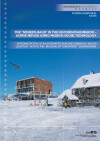
The "Schiestlhaus" In The Hochschwab Region - Alpine Refuge Using Passive House Technology
2/2005
Publisher: BMVIT
English, 6 pages
Publication Downloads
Developing of a application for central visualisation of the energy and resource demand in a private household "ZENVIS"
The main focus of the research project ZENVIS is set on the analysis of the benefits provided by a "visualization device", which gathers the readings of energy and resource consumption (electricity, gas, water, heat energy and fuel consumption). This device ought to find its use in households and to allow the consumer to observe and to control his energy consumption.
Connection of innovative strategies and technologies to a holistic, resources-friendly plus energy building (FUTUREbase)
On the basis of a construction project in Giefinggasse 4 in Vienna the combination of new, innovative strategies and technologies to an integrated, resources conserving plus energy building with high signaling and multiplication effect had been tested for feasibility. A regional, energetical bond between the buildings TECHbase, ENERGYbase and the Klima-Windkanal had been developed.
Adjustment of the value chain in the mass-shoe-production to customized production by unitized products and processes
Main topic of the project is the incremental change of business logics in mass shoe production by changing product-push to customer-pull concepts. Results need to integrate the entire supply chain, add value to the brand and its products and contribute to the company's sustainability.
"Building of Tomorrow" on the road - knowledge transfer of the results from "Building of Tomorrow" to existing traineeships
Knowledge transfer of the programme "Building of Tomorrow" to specialists on universities, advanced technical colleges, polytechnics, construction academies, administration academies. Themes: Energy, Construction and Building Physics, Ecology and Architecture and Sociology.
Raise in efficiency due to optimized waste heat management in heat intensive processes of the metal-working industry
This project drives at optimizing the energy input at the manufacturing process of oil tempered spring steel. This aim is met by investigating different options of waste heat recovery from industrial furnaces and heat insulation of heat treatment bathes. Besides, options of lead removal from anthracite will be listed.
Integration of aspects of sustainable investment into the training programme of selected financial service providers
Awareness raising and knowledge transfer by means of information processing and training of financial service providers concerning sustainable investment
Deliverable B1: Methodologies and Software Tools for Integrating Solar Heat into Industrial Processes (2015)
Publisher: IEA SHC Task 49
English, 27 pages
Publication Downloads
Ways and means to increase the construction-volume by 500%, by means of standardised thermal restoration of old houses.

Development of practise-fit methods for intensification and rationalisation of processes in the field of restoration of one-and two-family houses built between 1945 and 1982 in Austria.
Build to satisfy: Modeling of user behavior in lowest and plus energy buildings: Consequences for building and comfort
Aim of the project was a better understanding and modeling of effects of user behavior on energy performance in office and service buildings, built with lowest energy building and plus-energy building techniques. The results support facility managers of office/service buildings and integrate gender and diversity issues.