
Energy R&D 2024: Public Expenditures in Austria
Bibliographic Data
Energy Research Survey 25/2025Andreas Indinger, Felix Bettin, Marion Rollings
Publisher: BMIMI
German, 154 pages
Content Description
Public spending on research, development and demonstration projects in the energy sector
totalled 401.1 million euros in 2024. This figure exceeded the previous Austrian record in 2023 by
90.3 million euros (a 29.1% increase).
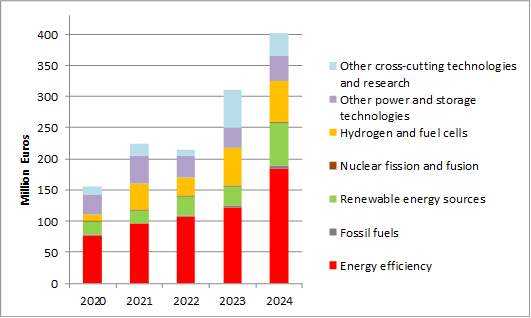
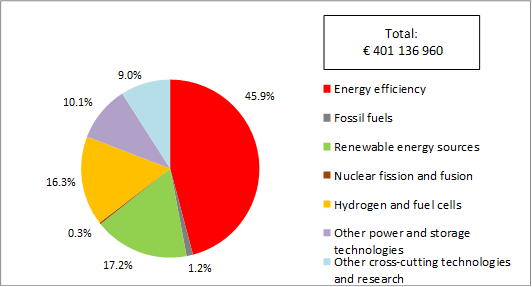
As in previous years, the "Energy efficiency" area is in first place with expenditure of 184.0 million
euros, an increase of 51.5% compared to the previous year. This is followed at a considerable
distance by the areas of "Renewable energy sources" with 69.1 million euros (an increase of
132.4% compared to 2023) and "Hydrogen and fuel cells" with a slight increase to 65.3 million
euros. The "Other power and storage technologies" area accounted for 40.5 million euros
(+30.3%), while the "Other cross-cutting technologies and research" area accounted for
36.3 million euros (-41.1%). In the "Fossil fuels" area, investments rose to 4.7 million euros, which
is particularly attributable to the area of CO2 capture and storage (CCS), while they fell slightly in
the "Nuclear fission and fusion" area to 1.2 million euros (-16.9%).
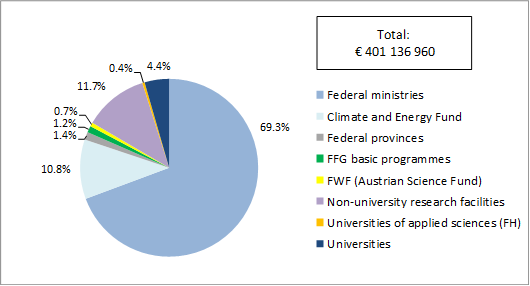
83.5% of the expenditure presented in this report in 2024 is direct financing from funding bodies
(federal government, federal states, funds). The federal ministries provided 278.1 million euros for
programmes in 2024, the majority of which (152.3 million euros) can be attributed to the former
Federal Ministry for Climate Action, Environment, Energy, Mobility, Innovation and Technology
(BMK). The Climate and Energy Fund reduced investments by a third to 43.4 million euros. The
expenditure reported by the federal states totalled 5.7 million euros, with Styria leading the way
with 1.8 million euros, followed by Upper Austria with 1.5 million euros and Vienna with
0.9 million euros. The expenditures of FFG basic programmes amount to 23,2 million euros (of
which 18,5 million euros from UG34). At 2.8 million euros, the funding provided by the Austrian
Science Fund (FWF) was only around a tenth of the unusually high level of the previous year.
The remaining 17.5% is accounted for by in-house research at research institutions financed by
federal or state funds. The Austrian Institute of Technology (AIT) and Silicon Austria Labs
dominated the use of own funds in energy research at non-university research institutions with
26.8 and 18.4 million euros, respectively. The reported own resources expenditure of the
universities (including the Institute of Science and Technology Austria – ISTA) rose to 17.8 million
euros. By far the highest expenditure came from the TU Wien (12.9 million euros). Expenditure
from the universities of applied sciences' own funds also increased slightly, totalling 1.7 million
euros in 2024.
Around 1,350 projects and activities were recorded in 2024. 42.1% of the funds were used for
applied research, while expenditure on experimental development accounted for 48.6%, a
significantly higher proportion than in 2023 (28.9%). Investments in first-of-its-kind demonstration
amounted to 6.1%, while those for energy-related research were 3.2%.
In 167 out of 387 of the projects commissioned by or via the FFG in 2024, at least one woman held
a leading position in the consortium. More projects were led by women in 2024 than in previous
years: 92 projects or almost one in four projects. On average, these female project managers were
responsible for projects with a comparable funding cash value to their male colleagues, meaning
the gap was almost closed for the first time. The proportion of women responsible for the
technical coordination of an organisation in the consortium is 20.6%. The respective proportions
vary greatly between the topics worked on and the funding programme lines.
Downloads
- Energieforschungserhebung 2024 – Ausgaben der öffentlichen Hand in Österreich (in German only) (pdf, 1.50 MB)
- Presentation Slides (English) (pdf, 459.61 kB)