
IEA DHC TS5 - Integration of Renewable Energy Sources into existing District Heating and Cooling Systems
Short Description
Objectives
District heating and cooling (DHC) based on renewable energy sources (RES) is a key lever for decarbonizing the heating and cooling sector. The holistic and complex processes required to transform large existing district heating and cooling systems towards higher RES shares are essential prerequisites for this transition. IEA DHC Annex TS5 examined these processes from different perspectives and developed methodological approaches. In addition to technical and economic challenges, the project focused particularly on long-term planning, data availability, stakeholder involvement, and the assessment of RES potentials for integrated transformation processes.
Content
The work was carried out in an international context within four Subtasks, complemented by national work packages (project management, preliminary work, dissemination).
- Subtask A addressed technologies and applications for integrating RES into existing DHC systems, as well as methods for potential assessment.
- Subtask B analyzed transformation processes of large DHC systems based on international case studies and developed a modular transformation guideline.
- Subtask C investigated the decentralized integration of renewable sources (e.g. waste heat, solar thermal energy), focusing on hydraulic integration, system operation, and business models.
- Subtask D focused on non-technical framework conditions such as regulation, stakeholder involvement, and governance.
Methodologically, literature reviews, case studies (including Graz), GIS-based potential analyses, and energy system modelling were combined.
Results
The results show that the technological foundations for a far-reaching decarbonization of DHC systems are available. Key findings highlight the importance of temperature reduction in networks, the integration of large-scale heat pumps and seasonal storage systems, as well as the increased use of industrial waste heat.
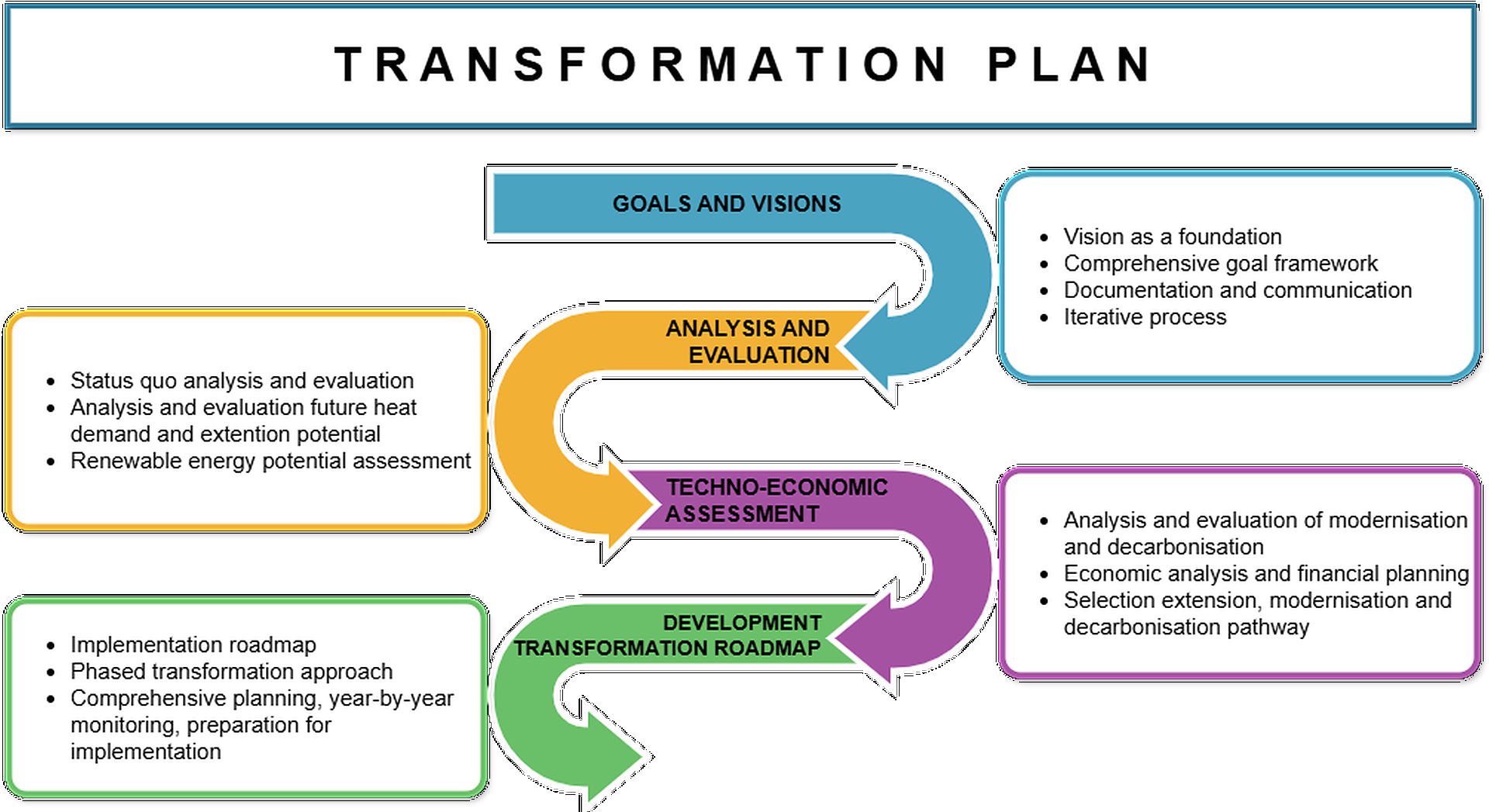
A major outcome is the developed transformation guideline, which for the first time provides an internationally aligned, modular methodology (goal definition, analysis, pathway development, roadmap) for planning and implementing decarbonization pathways, validated through case studies. In addition, standardized technology fact sheets and a methodological matrix for assessing RES potentials were developed, enabling high comparability and direct applicability in practice.
In the field of decentralized integration, the project demonstrated that local RES sources can make a significant contribution, but require enhanced solutions for network operation, hydraulics, and cooperation models. At the same time, the critical role of non-technical factors was clearly identified: stable regulatory frameworks, appropriate funding mechanisms, and early stakeholder engagement are essential for successful implementation.
Overall, the project confirms that the transformation of existing DHC systems must be understood as an integrated, iterative process combining technical, economic, and societal dimensions. For Austria, the results provide concrete guidance for municipal heat planning, funding policy, and infrastructure development.
Project Images
Terms of use: The pictures listed underneath the header “Project Pictures” originate from the projects in the frame of the programmes City of Tomorrow, Building of Tomorrow and the IEA Research Cooperation. They may be used credited for non-commercial purposes under the Creative Commons License Attribution-NonCommercial (CC BY-NC).
Participants
Austria, Canada, China, Denmark, France, Germany, Italy, Ireland, South Korea, Sweden, Switzerland, United Kingdom
Contact Address
Project leader
Michael Salzmann
AEE Institute for sustainable technologies
Feldgasse 19, 8200 Gleisdorf
m.salzmann@aee.at
Project partners
- Ingo Leusbrock
AEE Institut for sustainable technologies
Feldgasse 19, 8200 Gleisdorf
i.leusbrock@aee.at - Mostafa Fallahnejad
Institute of Energy Systems and Electrical Drives
Technical University Vienna
Gusshausstrasse 25-29/370-3, A-1040 Vienna, Austria
Fallahnejad@eeg.tuwien.ac.at - Lukas Kranzl
Institute of Energy Systems and Electrical Drives
Technical University Vienna
Gusshausstrasse 25-29/370-3, A-1040 Vienna, Austria
kranzl@eeg.tuwien.at - Markus Gölles
Automation and Control
BEST - Bioenergy and Sustainable Technologies GmbH
Inffeldgasse 21b, 8010 Graz, AUSTRIA
markus.goelles@best-research.eu - Christopher Zemann
Automation and Control
BEST - Bioenergy and Sustainable Technologies GmbH
Inffeldgasse 21b, 8010 Graz, AUSTRIA
Christopher.Zemann@best-research.eu - Ralf-Roman Schmidt
Center for Energy
AIT Austrian Institute of Technology GmbH
Giefinggasse 6 | 1210 Vienna | Austria
ralf-roman.schmidt@ait.ac.at - Edith Haslinger
Center for Energy
AIT Austrian Institute of Technology GmbH
Giefinggasse 6 | 1210 Vienna | Austria
edith.haslinger@ait.ac.at