
IEA AFC Annex 34: Fuel Cells for Transportation (Working period 2026 - 2027)
Short Description
Goals
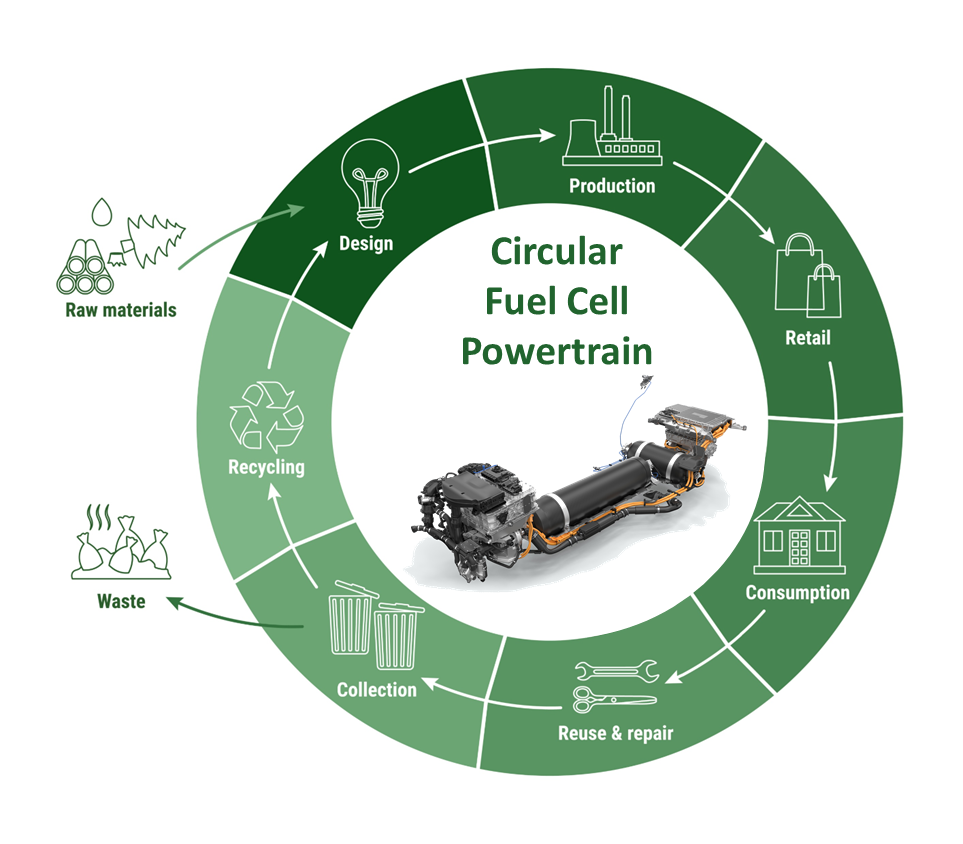
The project aims to promote the circular economy of fuel cell systems in FCEVs. It seeks to develop practical solutions for recycling, repair, and reuse. Specifically, the recovery of critical materials such as platinum and the efficient use of hydrogen tanks will be investigated. The project contributes to the development of international standards and best practices for the circular economy of FCEVs. The following figure shows the life cycle of a circular fuel cell powertrain. Starting with the raw materials, the powertrain goes through design, production, trade, and use, then is collected, maintained, or repaired, and finally recycled, with waste being returned to the cycle. The goal is a sustainable, closed material and energy flow.
Contents and Subtasks
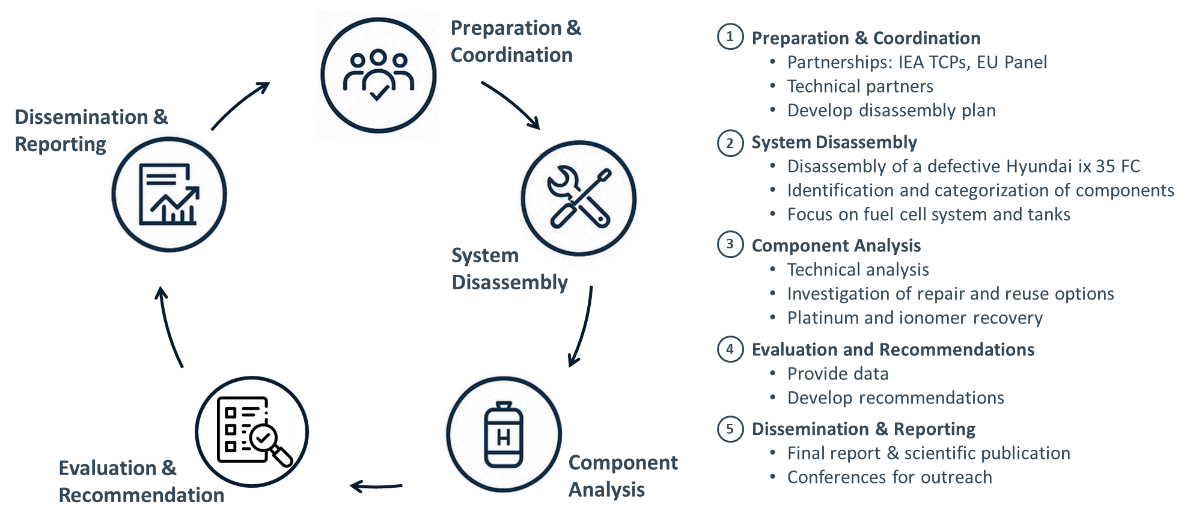
The project consists of several key tasks aimed at improving the circular economy for FCEVs. The following figure shows the project workflow. It begins with preparation and coordination, including partnerships and development plans, followed by dismantling of the system, whereby a defective Hyundai ix35 fuel cell system is examined. This is followed by detailed component analysis with technical investigation and testing of repair or reuse options, as well as recovery of platinum and ionomer. The cycle concludes with evaluation and derivation of recommendations, as well as dissemination and reporting through scientific publications and conference contributions.
Expected Results
The project will deliver the following results:
Disassembly and Condition Assessment
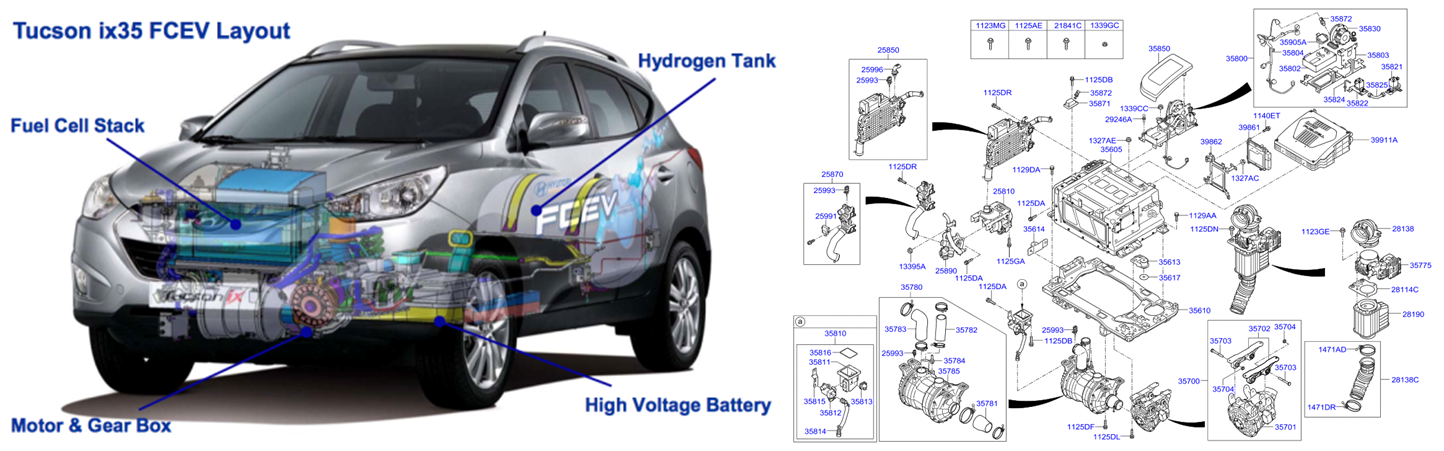
A detailed analysis of the FCEV will identify design flaws and material issues that hinder disassembly and repair. The following figure shows the individual components of a fuel cell system in the Hyundai ix35 FC.
Efficient Material Recovery
Methods for the effective recovery of platinum and other critical materials from fuel cell components will be developed.
Second-Life Potential
The investigation into the reusability of components such as the fuel cell stack and hydrogen tanks will provide important data for the implementation of second-life applications, e.g., in less safety-critical areas.
International Standardization
The insights gained will be incorporated into international guidelines for the disassembly and material recovery of FCEVs. These standards will support the development of a circular economy and facilitate the integration of FCEVs into sustainable mobility concepts.
The project will provide practical and scientifically grounded results that not only advance the circular economy of FCEVs but also contribute to the development of efficient recycling technologies and the creation of a more sustainable mobility system. Through collaboration with international partners, knowledge exchange will be fostered, and the development of globally applicable standards will be supported.
Participants
China, Denmark, Germany, France, Canada, Austria, Sweden, USA (Operating Agent)
Contact Address
HyCentA Research GmbH
Martin Aggarwal
Inffeldgasse 15
A-8010 Graz
E-Mail: aggarwal@hycenta.at