
ThermoCluster - Heat generation from infrastructure projects and integration into decentralised low-temperature heating and cooling networks for plus-energy districts
Short Description
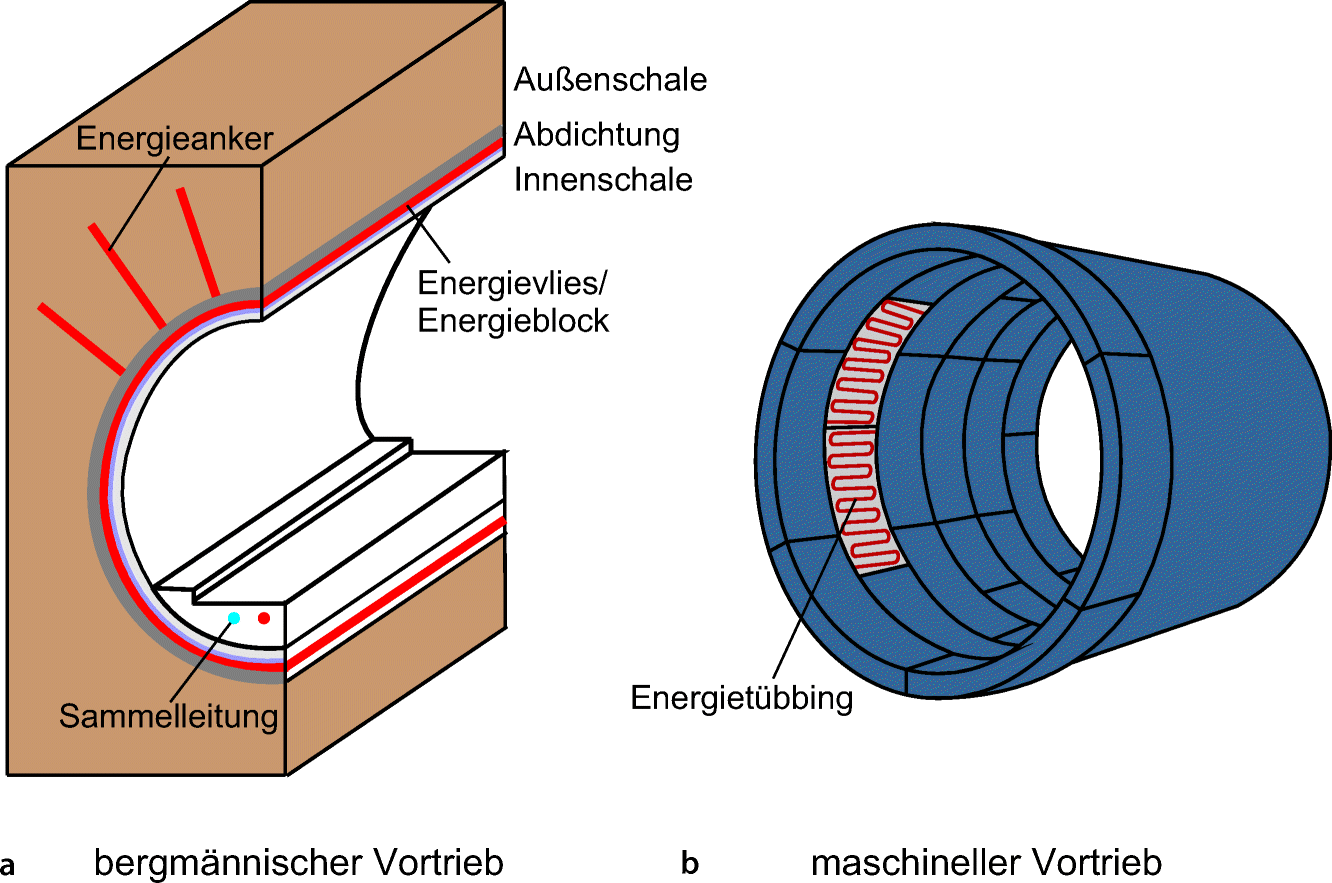
The use of geothermal energy from engineering structures and tunnels ("tunnel thermal energy") offers the possibility of using the components in contact with the ground for environmentally friendly heating and cooling in the local area (Adam, Markiewicz, & Oberhauser, 2005). In addition to the use of thermally activated tunnel components, discharged warm tunnel waters are also available in the Brenner Base Tunnel. Especially by using the tunnel waters, valuable synergy potentials. Due to the proximity to the city of Innsbruck, the Brenner Base Tunnel (BBT) offers the optimal framework conditions to determine the effectiveness and application limits of tunnel thermal energy, to simulate the energy distribution in the city and thus to explore the technical and economic feasibility. The aim of the project is to determine the geothermal potential of the BBT and its vicinity and to simulate the heat distribution in the city of Innsbruck. For this reason, this report is divided into these two parts. On the one hand, the heat potential of the Brenner Base Tunnel and its vicinity, and on the other hand, the distribution of the heat gained within the city of Innsbruck.
At the beginning, the water quantities and temperatures that will be discharged after the completion of the construction work of the Brenner Base Tunnel at the north portal were predicted. For this purpose, the measured data of the BBT as well as numerical models were used. With these results the usable heat capacities could be calculated and thus the geothermal potential could be limited in a still early phase. In addition, the hydrochemical parameters for the different waters were modeled and the precipitation rates were calculated. The geothermal potential in the target area was calculated using a methodology developed by the Geological Survey of Germany in the GEL-SEP project. Based on these results, potential analyses were then used to determine the optimal distribution structure.
The results show that the geothermal potential of the tunnel waters will range from about 2.8 MW to 6.5 MW, depending on the season and runoff development. The use of borehole heat exchangers in the target area would have a specific extraction power for heating and cooling with standard operating hours between 38.2 and 40.3 W/lm for the 0 - 100 m depth interval and between 39.3 and 40.8 W/lm for the 0 - 150 m depth interval. In addition, the annual energy amount for heating and cooling with standard operating hours varies between 80.5 and 85.6 kWh/m²/a for the depth interval 0 - 100 m and between 120.8 and 125.8 kWh/m²/a for the depth interval 0 - 150 m. The use of groundwater heat is generally possible in the study area, since a suitable near-surface groundwater body is found at the site. When comparing the different heat distribution scenarios, it was found during the comparison that an anergy network has the best conditions for efficient heat distribution.
When looking at the calculated energy quantities of the tunnel water utilization (or the mentioned water quantities as well as the water temperatures), it can be seen that there are still some uncertainties that cannot be narrowed down at this stage. However, these uncertainties will be eliminated as construction progresses. Despite these uncertainties, the results show a significant potential of the BBT tunnel water, which makes it essential to pursue the idea of geothermal use of the tunnel water. The potentials for geothermal probes are mainly dependent on the system parameters. It is important to emphasize that the system parameters are based on assumptions, and therefore the results are valid only for systems with the specified configuration. The use of tunnel heat to 18-23°C in an anergy network is considered to be technically the most advantageous (highest annual performance factors) and resource-saving for supplying the urban development areas. With the anergy network, the CO2-neutral mountain heat is provided most efficiently and according to demand with minimal exergy losses, and is raised decentrally by means of heat pumps to the useful temperature level of the low-energy buildings. A distribution of the mountain heat by means of an energy network over longer distances - to other parts of the city of Innsbruck - is, on the other hand, to be evaluated as inefficient due to higher line losses.
At BBT, the application of the system of sectional discharges and detailed monitoring forms the basis for estimating the geothermal potential. This broad data base makes it possible to make initial estimates several years before construction work is completed. The application of the partial disturbance system is therefore also an opportunity for other tunnels. In addition, the data enable optimization at an early stage. Due to the thermal regeneration of the groundwater during operation with balanced operating hours, an approximately three to four times higher amount of energy can be achieved in this case than during operation with standard operating hours. Therefore, a balanced mode of operation is preferable for both borehole heat exchangers and thermal groundwater utilization. From the current point of view, the use of the tunnel heat by means of an energy network is the technically recommended variant, since the tunnel heat with the prevailing temperature levels is suitable for the ground heat supply of the urban development area in the vicinity of the tunnel. An initial estimate based on investment costs also shows that an anergy network is the most economical variant, but under the condition that the return on investment can be achieved through corresponding revenues (from connection cost contributions, heat sales, and base or output price).
Project Partners
Project management
Thomas Geisler, Institute of Rock Mechanics and Tunnelling - Graz University of Technology
Project or cooperation partners
- AIT Austrian Institute of Technology GmbH, Center for Energy
- Galleria di Base del Brennero – Brenner Basistunnel BBT SE
- Innsbrucker Kommunalbetriebe Aktiengesellschaft
- Geological Survey of Austria, Department of Hydrogeology and Geothermal Energy
- University of Natural Resources and Life Sciences, Vienna, Institute of Applied Geology (IAG)
- University of Natural Resources and Life Sciences, Vienna, Institute for Chemical and Energy Engineering (IVET)
Contact Address
Thomas Geisler
Institute of Rock Mechanics and Tunnelling
Graz University of Technology
Rechbauerstrasse 12
A-8010 Graz
Tel.: +43 (316) 873 - 8615
Mobile: +43 676 9311194
E-mail: geisler@tugraz.at
Web: https://tunnel.tugraz.at